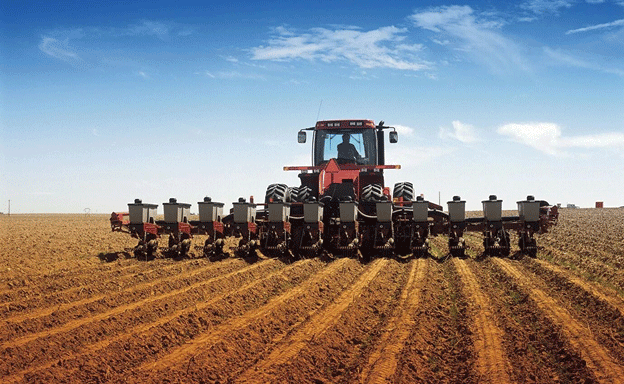
According to data from the Food and Agriculture Organization (FAO), over 90% of Israel’s wheat consumption is reliant on imports—a figure that continues to rise. This heavy dependence on foreign wheat highlights the impracticality of any policy aimed at blocking imports. Recognizing this, the Israeli government has implemented a “linkage” system: to import wheat, buyers must also purchase a certain percentage of locally grown wheat. Oren Harambam, head of the Consumer Products and Building Industries Association at the Manufacturers Association of Israel, explains: “When a flour mill or importer wants to bring in wheat, they must simultaneously purchase local wheat. This enables them to obtain an exemption from the 50% import duty, which otherwise makes importation unfeasible.”
The High Cost of Local Wheat
This system effectively gives a small group of licensed wheat traders the authority to sell wheat that buyers are compelled to purchase, setting a regulated—and exceptionally high—price. Hadar Golombik, CEO of Dagan Flour Mill, highlights the issue: “They take the highest global price, that of American wheat. Currently, American wheat costs $330 per ton, compared to $275 for European wheat.” The situation is even more problematic, as the wheat price includes shipping costs from the U.S. to Israel, despite the wheat being locally sourced. “The truck ride to my mill in Ashdod costs me as much as a ship from the U.S. to Israel,” Golombik adds.
The Impact on Bread and Dairy Prices
The artificially high price set for local wheat purchases significantly exceeds the market rate, a practice that dates back over 30 years to a time when wheat was imported primarily from the United States. Today, however, Israel imports most of its wheat from Russia, Ukraine, Hungary, and Central Europe. “There are years, like last year, where there was a dramatic difference of $70-80 per ton,” Harambam notes. This inflated price is inevitably passed on to consumers, not only in the cost of bread but also in dairy products. Wheat is grown across Israel, with about half of the 1.1 million dunams (approximately 273,000 acres) dedicated to animal feed and the rest for grain. Since wheat for bread is an alternative to wheat for animal feed, the artificially high prices imposed by the linkage system also drive up the cost of animal feed, which is the largest component in the Dairy Council’s formula for determining the price of raw milk for farmers.
Quality Concerns: A Barrier to Progress
The issues are not limited to cost alone; quality is also a major concern. “If you have to buy everything, there’s no room to negotiate on quality. You stick to the minimum standard set by the Ministry of Agriculture and don’t invest beyond that,” says Harambam. “There’s no enhancement of wheat varieties or development efforts to achieve healthier and higher-quality strains, such as those with higher protein content. If the protein content is low, the flour is not suitable for bread but more for biscuits, wafers, or animal feed. To make bread, especially high-quality bread, you need wheat with high protein levels.”
Rethinking Israel’s Wheat Strategy
Israel’s approach to wheat production and importation is fraught with challenges that undermine both its food security goals and the quality of its domestic wheat supply. The linkage system, while designed to protect local agriculture, results in inflated prices and poor-quality wheat that cannot compete with imported varieties. As the country continues to rely heavily on wheat imports, there is a pressing need to reevaluate the current policies and practices. Only through a more flexible and quality-focused approach can Israel hope to strengthen its agricultural sector and ensure that its food security strategy is both effective and sustainable.
Error