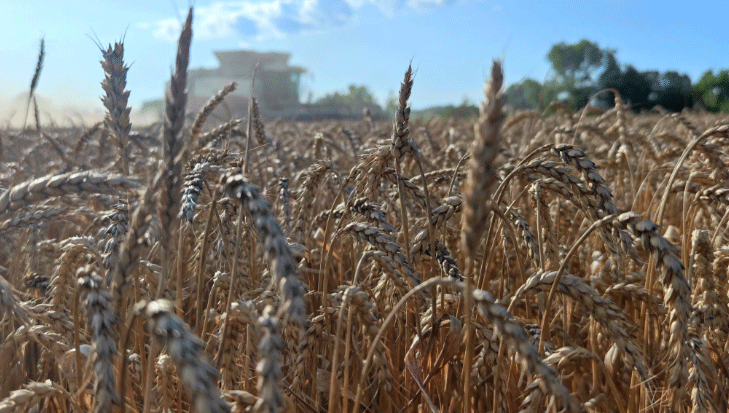
The first 119 wheat samples from the Krasnodar region’s 2025 harvest, representing 72,000 tons, have been analyzed by the Novorossiysk branch of FSBI “Central Grain Quality Assessment Center” (COK APK). The results indicate that 90% of the tested wheat meets food-grade standards, with 78% classified as Class 3 and 12% as Class 4, suitable for producing high-quality flour without additives. The remaining 10.8% falls into Class 5, typically used for animal feed or industrial processing.
Improved Gluten Content Compared to 2024
This year’s wheat demonstrates higher gluten levels than last year’s crop:
- Class 3: 26% gluten
- Class 4: 21% gluten
- Class 5: 20% gluten
Gluten content directly impacts baking quality, and these figures suggest strong flour performance for bread production.
Compliance with GOST Standards
All samples meet GOST 9353-2016 requirements, with key metrics including:
- Test weight: 760 g/L (Class 3), 794 g/L (Class 4)
- Protein content: 14.8% (Class 3), 13.2% (Class 4), 12.7% (Class 5)
- Falling number (enzyme activity): 383 sec (Class 3), 382 sec (Class 4), 373 sec (Class 5)
- No harmful impurities, contamination, or pest infestations detected.
Expanded Monitoring Across Southern Russia
The Novorossiysk branch will continue testing soft and hard wheat from 49 municipalities in Krasnodar Krai and the Republic of Adygea, with plans for 14,000+ samples and 267,000+ lab tests. This year’s nationwide grain quality monitoring provides free assessments to support farmers, traders, and policymakers in making informed decisions about domestic and export market strategies.
The initial data from the 2025 Kuban wheat harvest is highly encouraging, with 90% food-grade quality and elevated gluten levels pointing to excellent milling and baking potential. As harvesting progresses, final assessments will refine market expectations, but early indicators suggest a strong crop for both domestic consumption and export.
Error