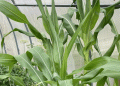

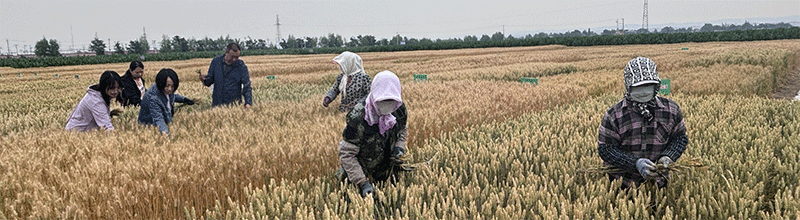
Farmers and agricultural scientists in Ningxia’s southern mountainous region have long struggled with winter wheat production due to challenges such as drought, lodging, susceptibility to stripe rust, and low yields. However, a significant breakthrough has been made with the successful development and approval of “Ningdong 24”, a new winter wheat variety bred for drought resistance, rust immunity, and high productivity.
From Challenges to Innovation
In the late 1980s, local wheat production relied heavily on introduced varieties and traditional landraces, which were often tall (prone to lodging), late-maturing, and vulnerable to dry winds and rust disease. To overcome these limitations, the Ningxia Seed Management Station initiated a breeding program focused on drought tolerance, rust resistance, early maturity, and high yield.
The breakthrough came in 2011 when researchers crossed “Longyuan 031” (drought and rust-resistant) as the female parent with “Xinmai 21” (high-yielding multi-spike variety) as the male parent. After years of selective breeding, “Ningdong 24” emerged as a superior cultivar, outperforming its parent strains in yield stability, disease resistance, and adaptability.
Enhanced Cultivation Techniques for Maximum Yield
To maximize the potential of “Ningdong 24”, the seed management team integrated advanced agronomic practices, including:
- Wide-narrow row furrow planting (improves light utilization and reduces lodging)
- Controlled-release fertilizer application (enhances nutrient efficiency)
- Drip irrigation technology (conserves water in arid conditions)
- Integrated pest management (“one spray, three defenses”) (reduces pesticide use while controlling diseases and pests)
These techniques have significantly improved crop resilience, ensuring stable yields even under adverse weather conditions.
Economic and Environmental Benefits
The introduction of “Ningdong 24” and “Lanhangxuan 151” (another rust-resistant variety) brings multiple advantages:
✔ Reduced pesticide use (due to rust resistance)
✔ Lower production costs (efficient water and fertilizer use)
✔ Higher yields (up to 15-20% increase compared to traditional varieties)
✔ Climate resilience (performs well under drought stress)
According to Wang Feng, director of the Seed Management Station, the next steps include expanding demonstration plots, conducting farmer training programs, and further refining breeding techniques to develop even more resilient wheat varieties.
A Step Forward for Food Security
The success of “Ningdong 24” marks a turning point in sustainable wheat farming, offering a climate-smart solution for regions facing water scarcity and disease pressure. By adopting these high-performance varieties and precision farming techniques, farmers can achieve higher profits while reducing environmental impact. Continued research and extension efforts will further strengthen food security and agricultural sustainability.
Error