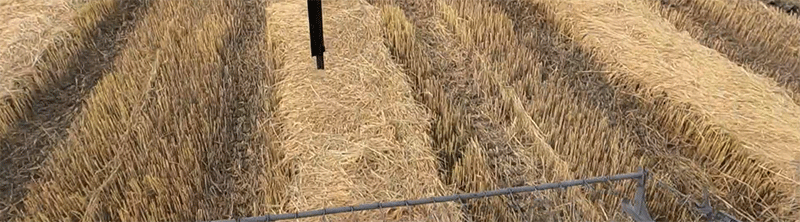
As the heart of Russia’s rice production, the Krasnodar Krai (Kuban) region is a bellwether for the challenges and innovations in modern cereal cultivation. This year’s harvest, spanning a vast 115,000 hectares (284,000 acres), is not just a routine operation; it is a testament to agricultural resilience. With over 700 combines deployed, farmers are engaged in what they describe as a “battle for grain” against a backdrop of unprecedented climatic volatility, testing the limits of their agronomic expertise and the genetic potential of their crops.
Conquering Climatic Adversity with Smart Genetics
The 2024 growing season presented a cascade of stressors. Producers like Svetlana Berezovskaya, a farm manager in the Slavyansk district, reported a trifecta of challenges: low temperatures at sowing, persistent rains in early summer, and a punishing drought that followed. This pattern aligns with broader observations of increased climate instability affecting major grain belts worldwide.
The key to mitigating these losses has been a strategic reliance on stress-tolerant rice varieties such as ‘Yakhont’ and ‘Rapan’. These cultivars, particularly ‘Yakhont’, have proven exceptional for their ability to tolerate deep water submergence—a critical trait during the early season floods. “When the barnyard grass dies, the rice remains alive,” explained Berezovskaya, highlighting a significant weed management advantage that reduces the reliance on herbicides. This is especially crucial on her 24 hectares of organic production, where chemical interventions are not an option.
The Precision of Harvest and the Proof of Quality
Beyond genetics, success hinges on meticulous timing. The harvest is a race against the weather to cut the crop at the precise moment when the grain is mature, yet the stalk must still dry in the field to facilitate threshing. This requires a seamless coordination of machinery and manpower, a “team effort from cultivation to processing,” as Berezovskaya notes.
The initial quality results are highly promising. The first 15,000 tonnes of grain sampled at the Novorossiysk testing laboratory have shown exemplary standards. Deputy Head of the Laboratory, Dmitry Savchenko, confirmed that the rice well within safe limits for pesticides, toxins, heavy metals, and radionuclides, with no detected genetically modified organisms. This clean bill of health is essential for both domestic market trust and international export potential.
Strategic Goals in a Changing Climate
Despite the seasonal challenges, the ambition for Kuban’s rice sector remains sky-high. With 116,000 hectares sown this year, the strategic goal for the next five years is to ramp up production to 2 million tonnes annually. Achieving this will require a dual focus: continued investment in climate-resilient agronomy and the expansion of high-value segments like organic production.
A Lesson in Adaptive Agronomy
The 2024 Kuban rice harvest offers a powerful case study for global agronomists and farm owners. It underscores that future food security will depend on:
- Genetic Resilience: Prioritizing the development and deployment of crop varieties bred specifically for abiotic stress tolerance (drought, flooding, cold).
- Precision Management: Leveraging precise timing and integrated team management to navigate narrowing harvest windows.
- Quality Verification: Maintaining rigorous, transparent quality control to certify food safety and meet evolving market demands.
For Krasnodar Krai, reaching its 2-million-tonne target will mean doubling down on these principles, transforming climatic challenges into opportunities for innovation and quality leadership in the global rice market.
Error