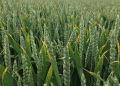
Farmers, agronomists, and agricultural researchers take note—Russia’s wheat production may be on the verge of a major leap forward. At the *All-Russian Field Day-2025*, scientists from the Samara Federal Research Center (Samara FRC) and the Rostov Agrarian Center introduced “Vertical,” a new intensive-type winter wheat variety promising record-breaking yields.
Why “Vertical” Stands Out
While official yield data from large-scale cultivation is still pending, early trials suggest that “Vertical” could outperform existing varieties by 10-15%, according to preliminary field observations. This aligns with global trends in wheat breeding, where modern cultivars—such as those developed in the EU and U.S.—have seen 5-20% yield increases due to improved stress tolerance and nutrient efficiency (FAO, 2024).
The variety was showcased alongside 13 other grain crops at a demonstration site, where winter wheat was sown in autumn and spring crops later planted. Such side-by-side comparisons allow farmers to visually assess performance, a critical factor in adoption decisions.
Farmer-Centric Breeding
Dr. Sergey Shevchenko, Head of the Selection Department at the Samara Research Institute of Agriculture (a branch of Samara FRC), emphasized the event’s value:
“Farmers get a rare chance to evaluate new varieties firsthand and discuss purchasing options directly with breeders. This bridges the gap between research and practical farming.”
This approach mirrors successful models in Canada and Australia, where farmer engagement in variety selection has led to faster adoption of high-performing strains (Nature Plants, 2023).
Market Potential & Challenges
Russia, already the world’s top wheat exporter (projected 50+ MMT in 2025/26, USDA), could further solidify its dominance if “Vertical” delivers on its promise. However, widespread success will depend on:
- Adaptability to diverse climates (particularly drought resilience, critical as 40% of global wheat areas face water scarcity (World Bank, 2024)).
- Cost-effectiveness for small and large farms alike.
The introduction of “Vertical” marks a significant step in Russian wheat breeding, combining high-yield potential with practical farmer engagement. If subsequent trials confirm its robustness, this variety could enhance both domestic food security and export competitiveness. For now, the agricultural community should monitor its performance in regional trials—this may be the wheat of the future.
Error