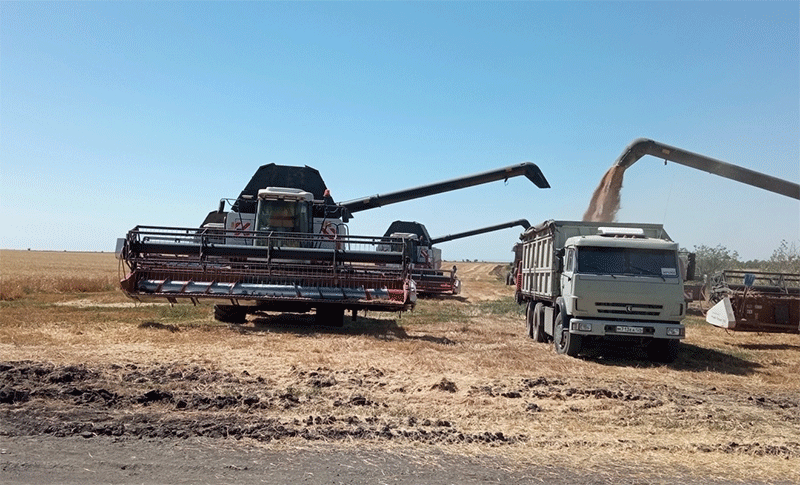
Agricultural producers in Russia’s Stavropol region have concluded the 2025 season with a historic achievement: a total grain and legume harvest of 10.6 million tons, an increase of 1.8 million tons over the previous year. The cornerstone of this success was a dramatic rise in wheat productivity, with average yields soaring from 3.6 tons per hectare (t/ha) in 2024 to 4.6 t/ha in 2025, representing a 28% increase. This impressive gain was cultivated from a stable sown area of 2.1 million hectares, demonstrating that the breakthrough was driven by intensity, not expansion.
Analysts attribute this record to a dual catalyst: strategically selected cultivars and conducive weather factors. The emphasis on “wisely chosen varieties” points to a targeted agronomic strategy, likely involving high-performance, regionally adapted seeds with improved stress tolerance and yield potential. This aligns with global trends highlighted in the 2024 FAO report The State of the World’s Plant Genetic Resources for Food and Agriculture, which underscores that leveraging genetic diversity and modern breeding is fundamental to closing yield gaps, particularly in established cropping regions. The acknowledgment of favorable weather also highlights the ongoing dependency of high yields on climatic cooperation, a variable becoming less predictable.
While the 4.6 t/ha yield marks a regional high for Stavropol, it invites comparison within the broader Russian and global context. For instance, leading wheat regions in the European Union often report average yields exceeding 7-8 t/ha, according to Eurostat data. Stavropol’s leap, therefore, signifies both a major local advancement and the identification of a significant remaining yield gap. Closing this gap further will require continuous investment in precision agronomy, soil health management, and climate-resilient farming systems to mitigate the risk of future adverse weather.
Stavropol’s 28% yield increase is a powerful testament to what is achievable when optimal genetic potential meets favorable growing conditions. It validates the critical importance of strategic variety selection as a primary lever for productivity gains. For agronomists and farmers worldwide, this case reinforces that sustained yield growth in mature agricultural zones depends on a continuous cycle of evaluating and adopting improved genetics, coupled with practices that maximize their expression. The challenge ahead lies in institutionalizing these gains by building resilience against the climatic variability that contributed to the very success of the 2025 season.
Error