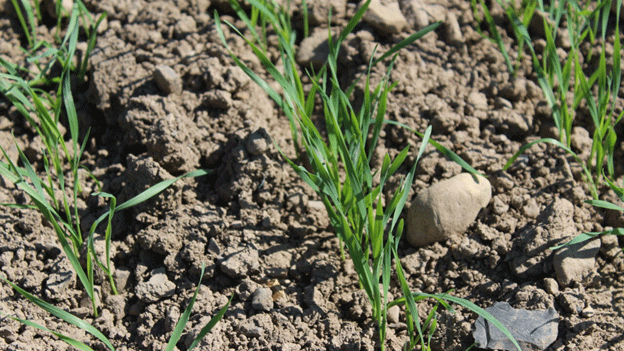
Thanks to a favourable March weather window, the sowing of spring cereals in Ireland is nearly complete, according to Teagasc. Wheat, oats, and beans are already in the ground across most regions, with only a small percentage of spring barley still to be sown in later areas. Following recent rain showers, crop growth has been visibly boosted, setting the stage for an active start to the 2025 season.
As we move further into April, growers drilling spring barley are advised to increase seed rates to ensure robust establishment. The target is to sow around 350 seeds/m², with the goal of establishing 300 plants/m² — crucial for yield stability in later-sown crops.
Fertiliser Management: Getting It Right from the Start
Balanced nutrient application at sowing is essential. The right fertiliser mix should provide:
- Sufficient nitrogen (N) for early establishment
- Phosphorus (P) to support root development
- Potassium (K) to aid stem strength and reduce lodging and brackling
Key Fertiliser Guidelines:
- P placement is especially beneficial on P Index 1 soils, as demonstrated in recent Teagasc spring barley trials.
- K application at 80–100 kg/ha can significantly reduce brackling, especially in high-yielding crops.
- Organic manures can offset fertiliser needs. Typically, 30% of total N can be applied at sowing.
- For feeding barley, split N applications are recommended: two-thirds at early tillering, one-third at GS31/32, reducing the risk of nitrogen losses and improving nutrient use efficiency.
Crop Protection: Early Monitoring and Action Are Essential
As crops advance beyond emergence, early intervention is key for pest and disease control:
Manganese Deficiency
- Common in spring cereals, especially in light or high-pH soils.
- Early symptoms (pale striping or spotting) must be treated immediately, or valuable tillers can be lost.
Aphid Management and BYDV Prevention
- March-sown crops generally do not require aphicides, unless grown in areas with a known BYDV history or near the coast.
- April/May-sown crops should receive an aphicide at the 3–4 leaf stage.
- Use full label rates and monitor fields post-treatment to detect resistant aphid populations.
Weed Control
- Apply herbicides at the 4–5 leaf stage using reduced rates for early weed control while keeping costs down.
- Best results occur when both the crop and weeds are actively growing.
- For wild oats, products like pinoxaden (Axial Pro 0.6 L/ha) or fenoxaprop (Foxtrot 0.8 L/ha) can be used — always check compatibility with other herbicides before tank mixing.
As Ireland’s spring sowing season wraps up, early attention to nutrient and crop protection strategies is critical to maximizing yield and grain quality — particularly in barley. Farmers should focus on targeted seed rates, split fertiliser applications, and timely pest and weed control based on field conditions and local risks. The combination of strong establishment and proactive agronomy will set the foundation for a productive 2025 harvest.
Error