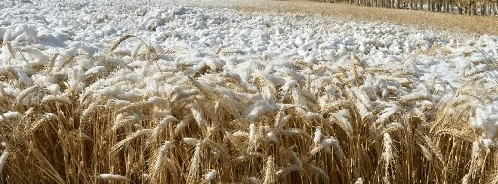
The 2024 harvest season in Kazakhstan’s northern breadbasket has been plunged into uncertainty following an unprecedented early snowfall in late September. While the Ministry of Agriculture urges calm, many farmers on the ground are reporting a dire situation. The snow arrived at the peak of the harvest, leaving tens of thousands of hectares of wheat and other crops like lentils and flax buried and inaccessible to machinery.
The human impact is immediate and severe. Anuarbek Alishev, a farmer with over 50 years of experience from the “Manai Agro” LLP in the Kostanay region, described the scene as catastrophic. “Everything is terrible,” he stated, estimating that some farmers have 50-60% of their grain still unharvested. He reported that crops like lentils are likely a total loss, painting a “plightful situation for farmers.”
A Clash of Perspectives: Field-Level Crisis vs. Ministerial Calm
The event has revealed a stark divide in risk assessment between producers and policymakers.
- The Farmer’s View: For those like Alishev, the snow “laid it down like a steamroller,” pressing wheat flat and causing immediate lodging. Beyond the snow, persistent rains in August and September had already delayed harvest and degraded grain quality. Alisher Khojanazarov, General Director of “Olzha Agro” holding, noted that the gluten content in his wheat has dropped to around 18 units, relegating much of the crop to lower, third or fourth-class quality, which carries a significantly lower market price. He also recalled the devastating 2023 season, where similar weather caused sprouting, forcing farmers to sell grain for as little as 40,000 tenge per tonne, a fraction of its normal value.
- The Official Stance: Vice Minister of Agriculture Azat Sultanov offers a more optimistic outlook. During a visit to the Kostanay region, he asserted that the snow was short-lived and has largely melted, comparing its moisture impact to a “light rain.” He emphasized that over 80% of the national harvest is complete, totaling more than 20 million tonnes, which secures domestic supply and export potential. His confidence lies in modern technology and specialty machinery, stating, “The bread will not remain in the fields.”
The Broader Context: Systemic Vulnerabilities and Global Precedent
This event is a acute symptom of the broader challenge of climate volatility. According to the Food and Agriculture Organization’s (FAO) 2023 Report on Climate Disasters, extreme weather events are increasingly disrupting agricultural calendars globally, with early frosts and unseasonal precipitation becoming more common.
Furthermore, Khojanazarov highlighted a critical systemic issue: absentee landownership and a lack of on-the-ground agronomic oversight. He pointed to poorly managed fields where seeding depth and timing are not controlled, stating, “The owner is in Astana or Almaty, there is no agronomist.” This lack of precision farming and local expertise exacerbates vulnerability when extreme weather hits.
Resilience Tested in a Volatile Climate
The situation in northern Kazakhstan is more than a simple weather delay; it is a stress test for the entire agricultural system. While the government’s macro-level data suggests resilience, the on-the-ground reports from farmers reveal significant localized losses, quality degradation, and financial strain.
The key takeaways for the global agricultural community are clear:
- Climate Resilience is Non-Negotiable: Farming systems must be fortified against increasingly unpredictable seasonal shifts.
- Quality is as Critical as Quantity: Events that degrade quality can be as economically damaging as those that reduce yield, impacting market competitiveness.
- Strong Local Management is Key: Centralized ownership without localized, expert management increases vulnerability to production shocks.
The final yield may not be a total failure, but the event underscores that for Kazakhstan’s farmers, the greatest challenge is no longer just growing the crop, but successfully harvesting it in the face of a rapidly changing climate.
Error