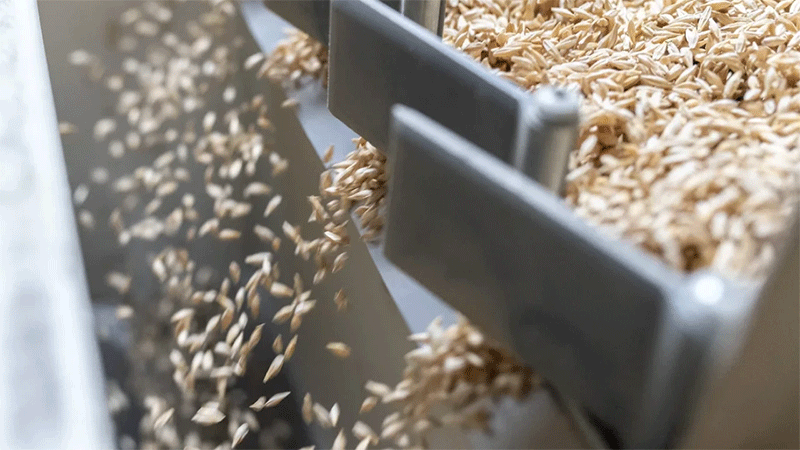
The Siberian Federal District has solidified its status as a powerhouse of Russian agriculture, reporting a 2025 grain harvest of approximately 19 million tons. This marks a substantial 20% increase over the previous year’s 15.9 million tons and continues a trend of record-breaking yields. While Siberia’s contribution to national export volumes remains modest—5% of grain and 3.4% of oilseed exports—its accelerating production growth is forcing a critical re-evaluation of its logistical and economic potential within the global supply chain.
The true story of Siberia’s agricultural rise is not just written in its fields but on its railroads and rivers. Record harvests are meaningless without pathways to market, and recent data underscores both progress and pressure. In November 2025, grain loading across the Russian Railways (RZD) network grew for the fourth consecutive month, reaching 3.4 million tons—a 26.4% year-on-year increase. Notably, shipments to domestic destinations surged 38.3% to 1.1 million tons, while export loadings grew 21.5% to 2.3 million tons. This rail data highlights a dual-track strategy: feeding internal demand while ramping up export capacity. To address the region’s landlocked geography, the Ministry of Agriculture and the Ministry of Transport are actively developing river transport logistics for Siberian grain, seeking more cost-effective alternatives to long-haul rail. This aligns with global trends; a 2024 World Bank report on agricultural trade corridors emphasizes that developing multi-modal transport (rail, river, and port) is essential for landlocked regions to remain competitive and reduce supply chain costs.
Furthermore, the reported 3% growth in food exports from the macro-region and the establishment of new trade links with Asia and South America signal a deliberate diversification effort. As noted by presidential envoy Anatoly Seryshev, Siberian products are in growing demand in these markets. This external focus is crucial. According to analysis from the FAO’s 2023 Agricultural Trade Policy Review, regions boosting export capacity must concurrently invest in meeting stringent international phytosanitary and quality standards to sustain long-term market access.
Siberia’s impressive 20% harvest growth is a testament to its agricultural potential, driven by improved practices and possibly favorable conditions. However, the region’s future as a stable exporter depends less on yield alone and more on the parallel development of its supply chain. The current reliance and strain on rail infrastructure, coupled with initiatives to unlock river transport, reveal a sector in transition. For agronomists and farm owners, the promise is clear: vast productive capacity. For engineers and policymakers, the imperative is equally clear: building efficient, multi-modal logistics is the critical next step to transform Siberian bounty into reliable, profitable global trade.
Error