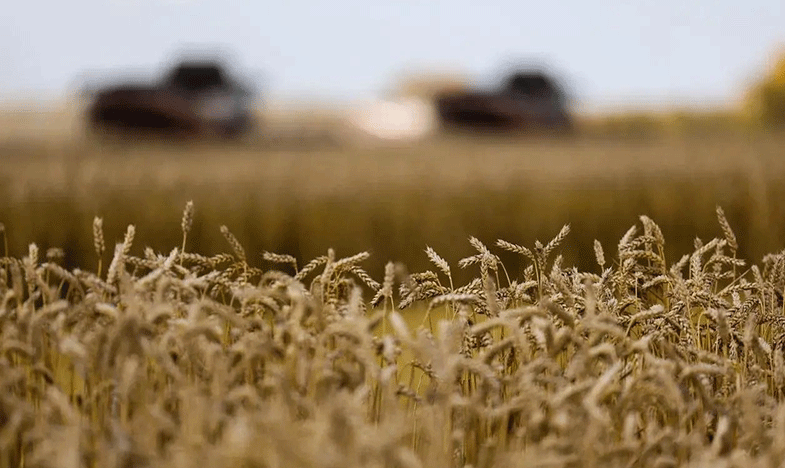
On the fields of Alexander Klochkov’s farm in the Omsk region, ten combine harvesters move through golden wheat, achieving yields of over 60 centners per hectare (approx. 6 t/ha)—a figure that rivals the fertile Kuban region in southern Russia. Yet, this bounty is met with frustration. “The grain market in Siberia is dead,” Klochkov states, citing domestic wheat prices as low as 8,500 rubles per ton, a stark contrast to the 15,000 rubles per ton seen just a few years ago. This price collapse dictates a single market strategy: the entire harvest of wheat, peas, and oilseed flax is destined for export to China.
This export reliance is not without its own pressures. Klochkov notes that the price for peas has also fallen, from 20,000 to 13,000 rubles per ton. This economic reality unfolds against a backdrop of significant agronomic and logistical challenges. The farm’s 2,400 hectares of wheat were planted predominantly with imported varieties, like the English wheat ‘Torridon’. Klochkov credits these foreign genetics with the farm’s success, arguing that domestic varieties would have failed under the season’s excessively wet conditions, which caused significant lodging and pre-harvest sprouting.
The harvest itself is a masterclass in overcoming adversity. Saturated soils have crippled efficiency; the fleet of ten combines can only manage about 100 hectares per day, half their potential capacity. Trucks cannot enter the fields, forcing combines to shuttle to the edges to unload, increasing fuel consumption and time. This logistical nightmare is managed with modern technology—GPS in every cab and radio coordination—but it cannot eliminate the fundamental constraint of the land.
Beyond the field, the farm is a model of post-harvest precision. A state-of-the-art reception point features a powerful dryer, modern storage sheds, and a laboratory equipped with instruments costing up to 3 million rubles each to analyze gluten, protein, and falling number. This focus on quality is essential for meeting export standards. However, this technical proficiency contrasts sharply with a human capital crisis. Despite combiner operators earning up to 10,000 rubles per day (paid 100 rubles/ton), the workforce is aging. “Young people don’t go into agriculture,” laments one operator, highlighting a profound demoralization fueled by the low value placed on their product.
Alexander Klochkov’s operation embodies the dual reality of high-tech, high-yield agriculture in a distorted market. It demonstrates that production excellence—driven by global genetics, modern machinery, and sophisticated post-harvest management—is no longer enough to ensure profitability. When domestic markets fail, farmers become entirely dependent on volatile export channels. The situation underscores a systemic risk: without a viable economic model that values their output, even the most efficient and dedicated producers face an uncertain future, and the next generation may see no future in the fields at all.
Error