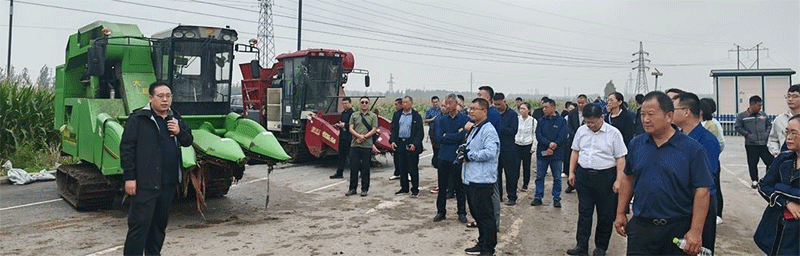
Against the pressing backdrop of the autumn harvest and the critical window for winter wheat planting, the city of Qingdao has taken a decisive step towards a more resilient and productive agricultural future. On September 28, 2025, the city hosted the “Green Grain Increase: Corn Machine Harvesting and Wheat Precision Seeding Quality Improvement Observation and Exchange Event” in Pingdu City. This was not merely a static exhibition but a dynamic, hands-on demonstration of how integrated technology is solving real-world problems for modern farmers.
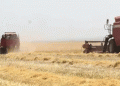
The event strategically addressed the two most critical phases of the “Three Autumns” production period simultaneously. For the corn harvest, the focus was on mitigating loss and climate risk. With recent heavy rains threatening to delay harvests and spoil yields, the event promoted the use of tracked corn harvesters. As explained by agronomist Yin Shiyang from the Municipal Agricultural Technology Center, these machines offer superior stability and can operate in wet field conditions where conventional wheeled harvesters would be immobilized. This capability directly addresses a major pain point, a fact underscored by large-scale grower Hou Songshan, who expressed relief that his 2,000 acres of corn could be harvested on time regardless of weather, preventing post-harvest losses.
The transition from harvest to sowing was seamless at the demonstration. The spotlight then turned to wheat establishment, with a demonstration of high-performance precision seeders. These advanced machines are a leap beyond basic equipment, capable of performing combined operations—seeding, fertilizing, and covering soil—in a single pass. Their most significant feature is the integration with BeiDou satellite navigation. When towed by a tractor equipped with BeiDou, the seeder maintains precise speed and positioning, eliminating skipped or overlapping rows. Officials reported that this technology can increase seedling emergence quality and boost per-mu yield by over 10%, a critical gain in the pursuit of “green grain increase.”
This hardware demonstration was supported by a deep dive into the software of modern farming: data. The smart agriculture exhibition area detailed how core technologies like high-precision positioning, multi-source data fusion, and AI-driven decision support are being practically applied. Experts illustrated how these systems, often referred to collectively as “BeiDou + Smart Agriculture,” are optimizing everything from water and fertilizer management to pest and disease control. This represents a fundamental shift in farming methodology, moving the industry from being “experience-driven” to “data-driven.”
To ensure these technologies are effectively adopted, Qingdao is backing the hardware with human capital. The city has organized an extensive training and support network, having already conducted 15 training sessions for 730 machine operators and serviced over 10,000 pieces of agricultural machinery. Furthermore, a robust safety net of 54 emergency service teams and 37 socialized service organizations has been mobilized, ensuring that the entire production chain is supported from “field to hand.”
The Qingdao event serves as a powerful case study in holistic agricultural modernization. It successfully demonstrates that increasing grain output—the “green increase”—is not solely about higher inputs, but about smarter integration. By combining resilient machinery like tracked harvesters with data-centric technologies like BeiDou-guided seeding and AI analytics, farmers can build a more defensive and productive operation. This approach directly tackles pressing challenges like extreme weather and labor efficiency, ultimately securing the path from “bumper harvest in the field” to “bumper grain in the bin.” For agronomists and farm owners worldwide, it underscores that the future of profitability and sustainability lies in the seamless fusion of powerful hardware and intelligent data.
Error