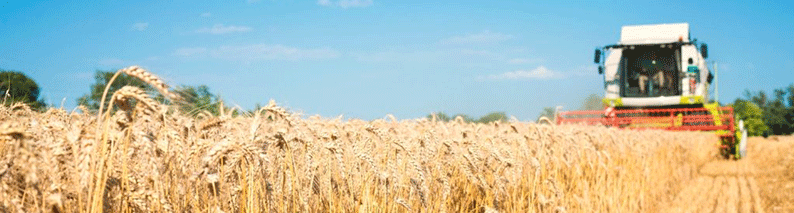
As of September 1, 2025, Orenburg Oblast, a key grain-producing region in Russia, has reached a significant milestone by harvesting over 3 million tons of grain. With 61% of the planned area (1.484 million hectares) combined, the initial data provides a robust snapshot of the season’s progress, highlighting both overall successes and notable variations in productivity across the region’s districts.
Yield Analysis: Regional Disparities and Performance
The average yield for the region stands at 20.2 centners per hectare (2.02 t/ha). This figure sits within the historical range for Orenburg’s often challenging, semi-arid continental climate. However, the more compelling story is found in the significant yield disparities between leading and average districts.
The top-performing areas demonstrate the potential achievable with optimal agronomic practices and favorable micro-climates:
- Buzuluksky and Grachevsky Districts lead with a yield of 31.4 c/ha (3.14 t/ha).
- Kurmanaevsky District, the leader in total tonnage (201.4k tons), achieved a yield of 30 c/ha (3.0 t/ha).
These yields are comparable to those seen in more central Black Earth regions and suggest successful adoption of moisture-preservation technologies, improved drought-tolerant seed varieties, and potentially more favorable local rainfall patterns. The gap between these high performers and the regional average underscores the impact of soil quality, precipitation distribution, and farm-level management decisions on final output. This variability aligns with global patterns; a 2024 report by the FAO on climate-smart agriculture emphasizes that yield gaps within a single region can often be larger than those between countries, driven largely by access to technology and management practices.
Logistical Progress and Winter Sowing Campaign
The harvest pace of 61% completion is strong, ensuring a significant portion of the crop is secured before potential autumn weather complications. Simultaneously, the crucial winter sowing campaign for the 2026 harvest is well underway. Farmers have already sown 349,300 hectares of winter cereals, representing 42% of the planned total area of 833,600 hectares.
This parallel activity is a critical test of logistical capacity. Timely sowing of winter crops after harvest is essential for ensuring good seedling establishment before winter dormancy, which is a key determinant of next year’s yield potential. The ability to manage both operations efficiently is a hallmark of a well-organized agricultural sector.
The 2025 harvest in Orenburg Oblast is on track to be a solidly successful one, with a total output exceeding 3 million tons. The data reveals a tale of two agricultural realities: one of high productivity in leading districts, showcasing the region’s potential, and another of a lower regional average that reflects the ongoing challenges of its production environment. The key to future growth and stability for Orenburg’s farmers lies in bridging this yield gap. This will require a intensified focus on transferring knowledge and technology from the highest-performing districts to others, promoting practices like no-till farming for moisture conservation, utilizing drought-resistant varieties, and optimizing fertilizer use. The progress on winter sowing is a positive sign, indicating that the sector is already looking ahead to secure next year’s harvest.
Error