

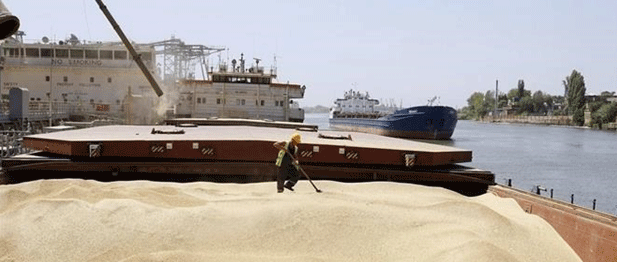
As Indonesia strives to strengthen its food security, the government is considering wheat imports as a viable option to replace domestic corn in animal feed production. This decision emerges from the challenge of balancing domestic agricultural production with growing demand in the country. With a focus on ensuring affordable prices for poultry farmers, Indonesia’s consideration of wheat imports sheds light on the complexities of agricultural policy and the ongoing efforts to reduce dependency on foreign food supplies.
Domestic Corn Supply and the Need for Wheat Imports
Indonesia has faced challenges in maintaining a stable domestic supply of corn, a critical ingredient in animal feed production, especially for poultry. In recent years, the country has relied on imports, with the volume ranging between 1.3 to 1.4 million tons of corn annually from 2019 to 2023. Despite these efforts, the government is now contemplating wheat as an alternative when domestic corn fails to meet the demand.
Wheat has been proposed as a cost-effective substitute due to its lower price compared to other feed grains, making it an attractive option when corn prices spike or when local production falls short. However, the government emphasizes that wheat imports will only be considered when there is a significant supply gap in domestic corn production, ensuring that imports are a last resort.
Shifting Toward Self-Sufficiency in Corn Production
To address the supply gap, Indonesia has made strides toward increasing domestic corn production. The forecast for 2025 is promising, with an expected output of 16.7 million tons, surpassing the domestic demand of 13 million tons. This increase is part of a larger strategy to cut back on imports and focus on self-sufficiency. In 2024, the government reduced the import quotas for corn, salt, and sugar to encourage local production and reliance on domestic resources.
As the domestic corn output increases, it is anticipated that the dependency on wheat as an animal feed ingredient will decrease, aligning with Indonesia’s long-term goal of reducing its dependence on imports for critical food staples.
Indonesia’s Broader Agricultural Goals
The Indonesian government has set ambitious goals to achieve self-sufficiency not only in rice but in other essential food commodities, including corn, wheat, and sugar. Under the leadership of President Prabowo Subianto, Indonesia is working to regain its past self-sufficiency in food production, particularly in rice, sugar, and garlic, which the country used to produce in abundance before the late 1990s.
The efforts to reduce reliance on imported wheat and other key ingredients reflect the government’s drive to promote local production and ensure more sustainable and secure food sources for the future. In this context, the proposed wheat import policy serves as a contingency measure to stabilize the agricultural sector in the short term while fostering long-term growth in domestic crop production.
Indonesia’s decision to consider wheat imports for animal feed highlights the dynamic challenges faced by nations in balancing domestic agricultural production with consumer demand. As the country aims to reduce its dependence on imports, the increase in local corn production presents a step toward self-sufficiency. While wheat may serve as a temporary substitute, the focus remains on building a more resilient and self-reliant agricultural sector in the long term.



