

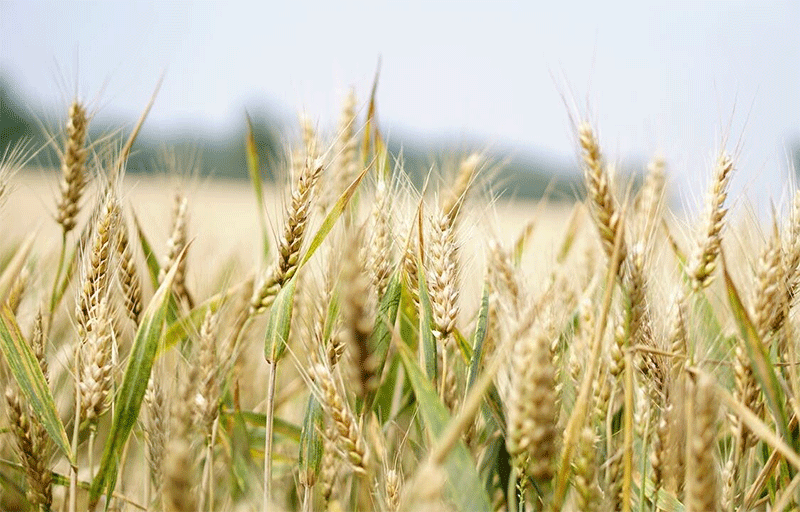
For farmers, agronomists, and farm owners focused on sustainable intensification, the quest for greater resilience and consistent yield is constant. A promising strategy gaining renewed scientific interest is the cultivation of variety blends—sowing multiple genetic varieties of a single crop, like wheat, in the same field. A new, ambitious four-year project funded by the UK’s Agriculture and Horticulture Development Board (AHDB) is set to move this concept from anecdotal evidence to actionable, data-driven insight, specifically for the milling wheat sector.
The Rationale for Blending: More Than the Sum of Their Parts
The initiative was born from a need identified in AHDB’s Recommended Lists (RL) review. The hypothesis is compelling: while single-variety stands (straights) are the norm, a strategic blend could outperform them by leveraging complementary traits.
According to the AHDB, the potential benefits extend beyond raw yield:
- Yield Stability: Blends can buffer against environmental variability, as different varieties may respond differently to stressors like drought or heat.
- Reduced Disease Severity: Genetic diversity can act as a natural barrier, slowing the spread of pathogens like septoria tritici and yellow rust. This is a crucial finding in an era of increasing fungicide resistance. A 2022 meta-analysis in Nature Plants concluded that crop diversification (including variety mixing) significantly reduces disease severity, with a median effect of reducing pest and pathogen damage by over 20%.
- Enhanced Sustainability: By naturally suppressing diseases, blends can reduce dependency on fungicide applications, contributing to resistance management and lowering input costs and environmental impact.
- Prolonged Gene Durability: Blending can help protect the efficacy of valuable disease-resistance genes by presenting a more complex challenge to evolving pathogens.
A Rigorous Scientific Approach
This project will transcend previous modelling by gathering empirical field data. It will utilize the AHDB’s winter wheat blend tool as a starting point to identify potential hard milling variety combinations. However, as Georgia Hassell, the AHDB initiative lead, notes, “the tool data is based on varieties grown as straights, it does not account for complementarity of traits.” This research will fill that critical gap.
The experimental design is robust:
- Trials will run for three consecutive cropping seasons (autumn 2025-2027).
- Two distinct sites: Harper Adams University (Shropshire) for high septoria pressure, and Agrii Throws Farm (Essex) for high yellow rust pressure.
- Comparative Treatments: Each blend will be directly compared to its component varieties grown as straights.
- Fungicide Regimes: Plots will include both a low-/no-fungicide protocol to test innate resistance, and a high-intensity RL standard program to isolate the yield benefits of blending beyond disease control.
- Comprehensive Data Collection: Metrics will include disease levels, canopy development, growth stages, height, yield, and critically, end-use quality through milling and baking tests. The project will also analyze mycotoxin concentrations and record ergot presence.
The Irish Context and Parallels
In Ireland, dedicated research on cereal variety blending under local conditions is still in its infancy. However, the principles of intercropping are being actively explored. Teagasc is currently researching pea-faba bean intercrops, where the beans provide structural support to prevent pea lodging. Trials have confirmed that this partnership delays maturity slightly, offering harvest flexibility without compromising yield—a testament to the power of plant synergy.
This UK wheat blend project offers a valuable template and its results will be highly relevant for Irish scientists and farmers looking to build resilience into their systems.
The AHDB’s milling wheat blend project represents a significant step towards validating a more resilient and sustainable cropping model. By moving from theoretical tools to multi-year, multi-location field trials that measure both agronomic and quality parameters, it promises to deliver the robust evidence base the industry needs. If successful, variety blends could become a key strategy for farmers and agronomists to future-proof their crops against disease, climate volatility, and market demands for both high quality and sustainable production.
Error