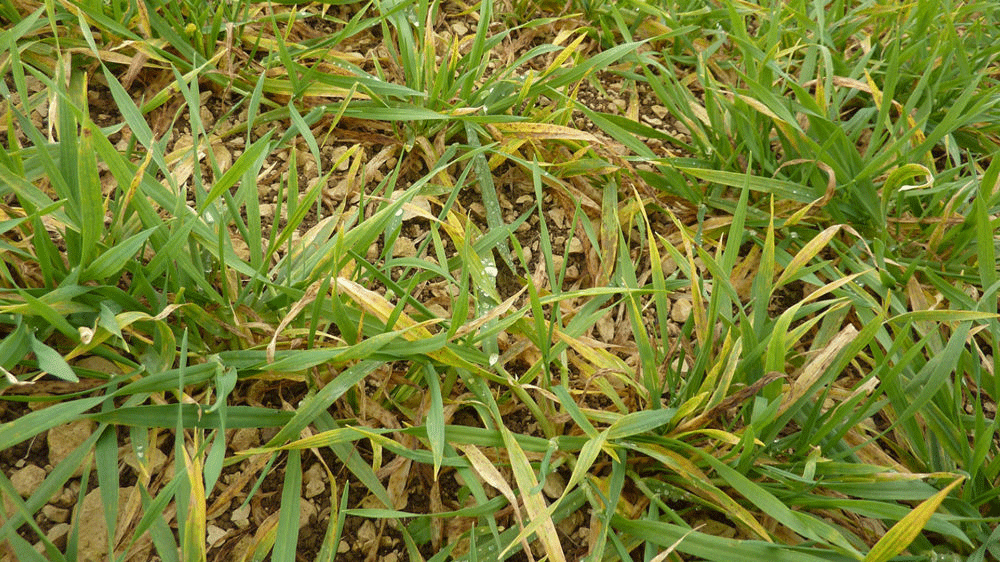
For winter cereal producers, the management of aphid-vectored Barley Yellow Dwarf Virus (JNO) and cicada-vectored Wheat Dwarf Virus (WDV) represents one of the most significant and unpredictable challenges. While insecticide treatments and sowing dates are critical tactical tools, the strategic foundation of any effective defense lies in the genetic choice of the seed itself. Recent multi-year trials in France (2022-2025) provide crucial, nuanced data on how soft wheat and winter barley varieties are performing against these viruses, offering a roadmap for building more resilient cropping systems.
Soft Wheat: A Spectrum of Susceptibility and the Rise of Partial Resistance
In soft wheat, JNO symptoms are often less dramatic than in barley, but yield losses remain economically significant. The key finding from recent trials is the high variability in symptom expression between varieties and across different sites and years. This underscores that while genetic tolerance exists, it is highly influenced by environmental conditions and pest pressure.
The most significant advancement comes from varieties carrying the partial resistance gene Bdv2. Varieties like RGT Tweeteo (the first Bdv2 variety registered in France in 2020) and the newly registered RGT Sundeo consistently demonstrate markedly lower symptom intensity. It is critical to understand that this is partial resistance; under high viral pressure, yield loss is not eliminated but is significantly reduced compared to susceptible varieties.
Among non-Bdv2 varieties, a clear hierarchy of performance exists. Varieties such as KWS Ultim, Winner, and RGT Pacteo have shown consistently lower symptoms, while others like RGT Cesario and Unik have been identified as highly susceptible, with correspondingly high yield losses. Notably, no soft wheat varieties in France currently carry official resistance or tolerance to Wheat Dwarf Virus, highlighting a major genetic gap and the continued need for vector control.
Winter Barley: A Mature Arsenal for JNO, with New Dual-Resistance Breakthroughs
The situation in winter barley is more advanced. The market has been transformed, with nearly all recently registered varieties now being JNO-tolerant. This provides a robust first line of defense, as these varieties tolerate the viral infection with far less yield penalty than susceptible ones. A critical development for the malting sector is the registration of the first JNO-tolerant six-row varieties, Carrousel and Constel, which are approved by French maltsters and brewers.
The most exciting frontier is the arrival of varieties with dual resistance. In 2024, KWS Innovatris became the first winter barley variety registered with tolerance to both JNO and Wheat Dwarf Virus. It has now been joined by KWS Melodis and KWS Futuris in 2025. This breakthrough is a game-changer, offering a genetic solution to the two most damaging viral diseases and reducing reliance on insecticide sprays targeting two different vectors.
The era of relying solely on chemistry for viral disease control is over. The integration of resistant and tolerant varieties is the cornerstone of a sustainable and economically viable strategy. For soft wheat, the strategic deployment of Bdv2 varieties like RGT Tweeteo and RGT Sundeo in high-risk situations can provide a crucial yield safety net, while careful selection among other varieties can further mitigate risk. For winter barley, growers have a powerful and diverse genetic toolbox, culminating in new dual-tolerant varieties that represent the future of integrated disease management. However, genetic resistance is not a silver bullet. It must be woven into a system that includes careful attention to sowing dates, vigilant monitoring, and targeted insecticide use only when necessary. By making informed, data-driven varietal choices, farmers and agronomists can build a more resilient foundation for cereal production.
Error