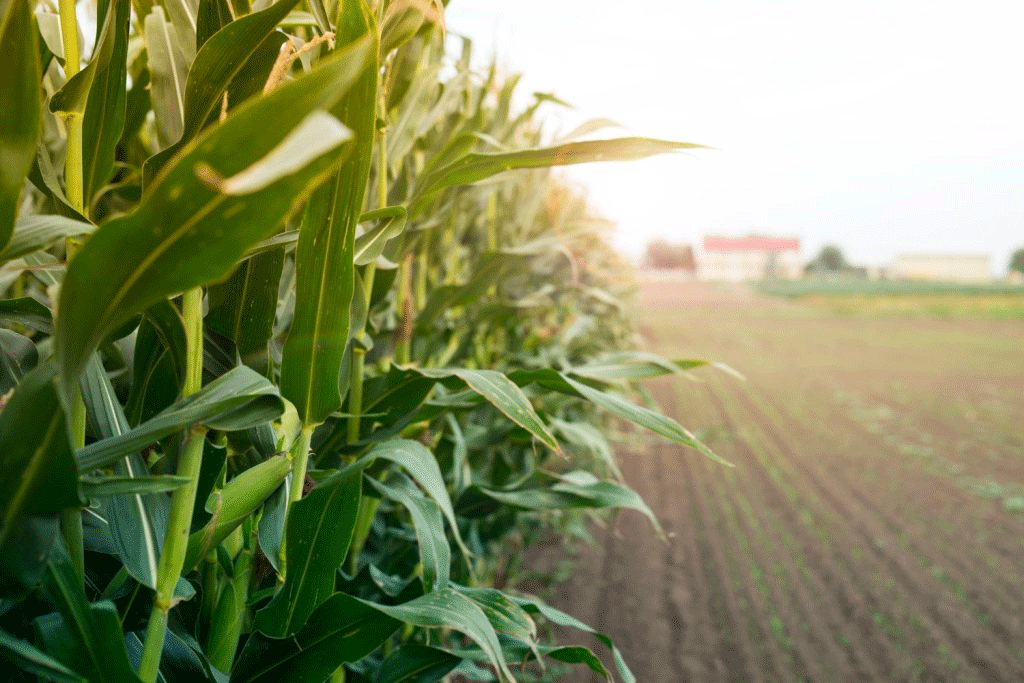
The 2025 harvest in Primorsky Krai has delivered an extraordinary result for corn, with a total production of 878,000 tons. This represents a dramatic 44% increase over the previous year, achieved from an area of 114,000 hectares. The average yield reached 7.7 tons per hectare (77 centners/ha), a significant 17% year-on-year improvement, confirming that the surge was driven by both expanded acreage and enhanced on-farm efficiency.
Placing these figures in context underscores their significance. Russia’s national average corn yield has seen steady growth, reaching approximately 6.0-6.5 t/ha in recent years, with leading regions in the Central Black Earth district achieving over 8.0 t/ha. Primorye’s leap to 7.7 t/ha brings it close to these national benchmarks, a remarkable feat for a region with a different climate and a historically smaller role in the national corn belt. This growth aligns with a broader national trend. According to the Russian Ministry of Agriculture, the country’s total corn harvest in 2024 was projected near a record 16-17 million tons, driven by both yield gains and strategic expansion of planting areas, particularly for export-oriented production.
Local officials, such as Minister Andrey Bronz, attribute the success to favorable sunny weather. However, consistent yield growth of this magnitude typically points to deeper agronomic advancements: the adoption of later-maturing, high-yielding hybrids suited to the region’s lengthier vegetative period, improved nutrient management, and precision planting techniques. The focus on seed is evident, with regional demand for seeding material already estimated at over 3,500 tons for the planned expansion to 130,000 hectares in 2026.
Primorsky Krai’s corn harvest is not an anomaly but a signal of strategic maturation. The data indicates a successful pivot towards advanced agronomy and capital-intensive farming, moving beyond mere area expansion. For farmers and agronomists, the lesson is the critical importance of hybrid selection and tailored crop management. For scientists and engineers, it highlights the need for continued R&D in varieties adapted to the Far East’s specific conditions. For farm owners and policymakers, this boom underscores Primorye’s growing potential as a reliable production hub, possibly for Asian export markets. The planned 2026 expansion to 130,000 hectares confirms this trajectory, making corn a cornerstone of the region’s agricultural future.
Error