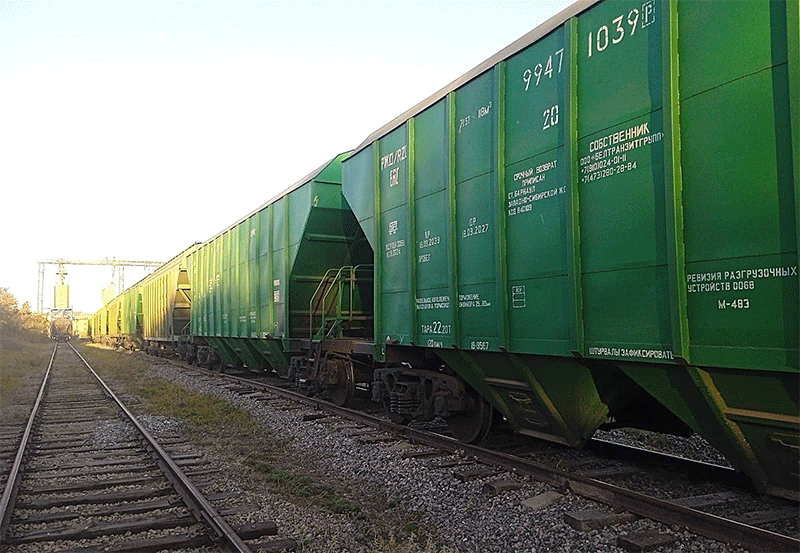
For over three to four years, a frustrating and costly cycle has crippled a crucial artery of Eurasian agricultural trade: the rail export of Kazakh grain to China. As reported by APK News, the current season has again seen Kazakh exporters raising alarms, unable to ship grain due to reported restrictions from Kazakhstan Temir Zholy (KTZ), the national railway company. KTZ, in turn, points to the Chinese side’s refusal to accept cargo. The core of the paradox was laid bare at a recent meeting in Kostanay: China’s receiving grain terminals are reportedly standing empty.
Kanat Kobesov, Chairman of the Board of the “Kaz Grain” Exporters Association, provided a stark assessment after a joint inspection commission visited key border points. The findings reveal a multi-faceted crisis:
- The Uzbekistan Bottleneck: Rail connections through Uzbekistan are operating at absolute capacity. Kobesov confirmed stations are “locked,” with Saryagash full and Uzbek terminals exhausted. Uzbekistan lacks synchronized infrastructure development, needing help with both locomotive power and terminal capacity. With a baseline capacity of about 40 trains per day, they have “exhausted all their reserves,” creating a significant secondary barrier.
- The China Conundrum: The situation on the Chinese border is more perplexing. Kobesov states that traffic flow is only at about 50% of the combined potential capacity of both sides’ stations. Crucially, he reported that the Chinese grain terminal for bulk unloading is empty, and the KTZh terminal is similarly underutilized. “The Chinese are blaming the Kazakhs, the Kazakhs are blaming the Chinese,” he summarized, calling for synchronized action on customs, phytosanitary controls, certification, and transit regulations at a state-to-state level.
However, KTZh’s representative presented a contrasting technical perspective. Kayrat Saurbayev, Director of the KTZ-Freight Transportation branch in Kostanay, asserted that China’s technical capacity remains limited to approximately 12 trains per day. While Kazakhstan has added 6 new tracks at the Altynkol station, potentially allowing for 3-4 additional trains, any real increase depends entirely on corresponding upgrades on the Chinese side.
Latest Context and Data:
This deadlock occurs against a backdrop of rising global demand and strategic shifts. China’s grain imports remain high, with 2023/24 corn imports forecast at a record 23 million metric tons (USDA). Kazakhstan, a key regional supplier, harvested over 16 million tons of wheat in 2023 (Kazakh Ministry of Agriculture). The urgency to resolve this bottleneck is economic and strategic. The inefficiency translates directly into lost contracts, financial penalties for Kazakh exporters, and undermines Kazakhstan’s potential as a reliable supplier in the critical China-Central Asia corridor. Furthermore, regional rail freight costs have been volatile, and delays compound these expenses, eroding competitiveness.
The “empty silos” of Altynkol are a symptom of a deeper, systemic issue that transcends simple blame. The problem is not a lack of grain or demand, but a critical failure of logistical synchronization and strategic infrastructure planning at an international level. The conflicting narratives—empty terminals versus fixed technical capacity—highlight a severe communication and coordination gap between railway operators and state agencies on both sides.
Resolving this requires an immediate shift from cyclical accusations to coordinated state-level action. Kazakhstan must internally prioritize its export corridors and wagon turnover, while engaging in high-level bilateral and trilateral (including Uzbekistan) negotiations. The goal must be a binding, synchronized roadmap for infrastructure investment, digitalized customs and phytosanitary procedures, and clear, increased throughput quotas. For farmers, agronomists, and traders, this deadlock represents lost revenue and stifled growth. For the region, it is a test of its ability to integrate its agricultural potential into efficient, modern supply chains. The solution lies not just in laying more track, but in building stronger diplomatic and operational bridges.
Error