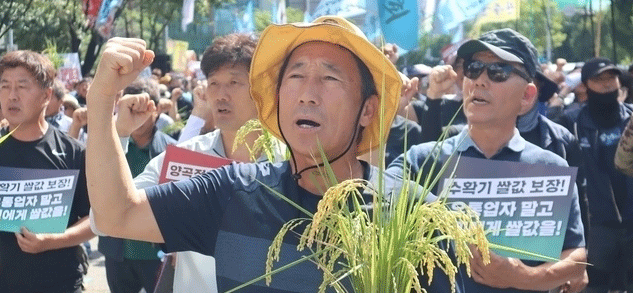
Recent protests by South Korean farmers, led by the National Federation of Peasant Associations (NFPA) and the National Rice Producers Association, highlight a critical and universal challenge in agriculture: the profound disconnect between market prices, production costs, and the financial viability of farming. While the immediate context is Korea’s tightly managed rice market, the underlying themes of market intervention, cost-price squeezes, and climate-related production risks resonate with farmers and agricultural professionals worldwide.
The Core of the Protest: A Misaligned Incentive Structure
On September 18, over 1,500 farmers gathered in Seoul to protest the government’s release of public reserve rice into the market. Their central argument was that while the wholesale price of rice has been rising—reaching 225,332 KRW per 80kg sack (approximately $210 per 100kg) as of mid-September—the benefits are captured by distributors and retailers, not producers.
Farmers, burdened by debts accrued from soaring production costs (fuel, labor, fertilizers), were often forced to sell their paddy (unmilled rice) at a loss at the end of the previous year. This cost-price squeeze is a global phenomenon. According to the Food and Agriculture Organization (FAO), global food prices have remained volatile, but the Agricultural Market Information System (AMIS) highlights that input costs, particularly for fertilizers and energy, have seen sustained high prices since the war in Ukraine, compressing farm margins globally.
Policy Interventions and Unintended Consequences
The protesters sharply criticized the government’s decision to release 55,000 metric tons of public reserve rice to alleviate shortages for distribution companies. They view this as a deliberate move to suppress prices at the precise moment farmers expect to benefit from seasonally higher harvest prices.
This tension is a classic case of the government’s dual role: ensuring affordable food for consumers while guaranteeing fair incomes for producers. The Korean government’s policy of reducing rice cultivation area to balance supply and demand was also cited as a contributing factor to the current tight supply. This aligns with a global trend where climate change is exacerbating production uncertainties. The 2023 IPCC Report reiterates that increasing frequencies of extreme weather events are making yield predictions more difficult, suggesting that blanket reduction policies carry significant risk.
The Broader Context: Trade Agreements and Market Fears
Adding to the immediate market concerns is the long-term fear of international trade agreements. The Korean groups specifically called for a halt to discussions on joining the CPTPP (Comprehensive and Progressive Agreement for Trans-Pacific Partnership), fearing an influx of cheaper imported rice that would further undermine domestic prices. This reflects a broader anxiety among producers in protected markets about global competition.
A Call for Data-Driven and Equitable Policies
The situation in Korea is a microcosm of a global agricultural dilemma. Effective agricultural policy must be nuanced and forward-looking. It requires moving beyond reactive measures like emergency reserve releases and towards holistic strategies that:
- Decouple Farmer Income from Volatile Market Prices: Exploring direct payment schemes or enhanced crop insurance models that ensure baseline profitability without directly manipulating the market.
- Integrate Climate Intelligence: Using advanced data analytics and climate forecasting to make more informed, responsive decisions on planting guidance rather than static area reductions.
- Enhance Supply Chain Transparency: Implementing systems, potentially through blockchain or traceability tech, to ensure a fairer distribution of profits from the consumer back to the primary producer.
The demands of the Korean farmers—for a guaranteed price that covers production costs and a stop to policies that depress harvest-time income—are not isolated grievances. They are a urgent call for policies that are not only fiscally sound but also equitable, sustainable, and resilient enough to feed a nation without bankrupting those who work the land.
Error