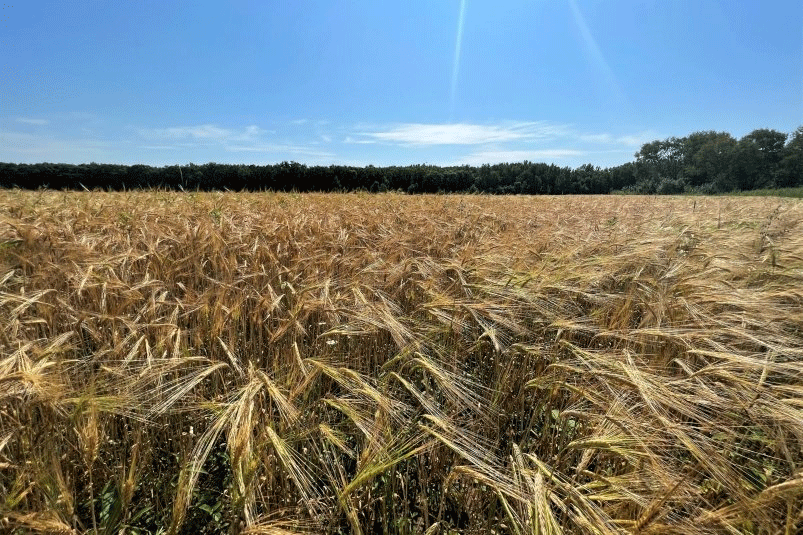
As combines roll across the fields of the Jewish Autonomous Region (EAO), the 2024 harvest season offers a critical snapshot of cereal and legume performance in Russia’s Far East. With early grains nearing completion and row crops soon to follow, current data reveals both consistent yields and emerging opportunities for producers and agronomists tracking the region’s output.
According to the latest official reports, the total area dedicated to early grains in the EAO stands at 4,772 hectares, of which 1,838 hectares (38.5%) have been harvested to date. The current gross harvest has reached 3,022 tonnes, maintaining an average yield consistent with last year at 16.5 centners per hectare. A crop-specific breakdown provides a clearer picture of performance:
- Barley: This was the first crop to mature. From a sown area of 1,372 hectares, 514 hectares have been harvested, producing 859 tonnes at a yield of 16.7 centners/ha.
- Wheat: From 1,719 hectares sown, 458 hectares have been cut, yielding 616 tonnes at a rate of 13.4 centners/ha.
- Oats: Demonstrating strong performance, oats are currently the most actively harvested crop. From 1,681 hectares, 866 hectares have been harvested, producing 1,547 tonnes at a leading yield of 17.8 centners/ha.
Regional variations highlight the impact of localized management and conditions. The Birobidzhan municipal district, for instance, is reporting a barley yield of 17.9 centners/ha, outperforming the regional average.
The harvest window is now transitioning. The active harvesting of oats will soon be followed by the larger campaigns for corn, rice, and soybeans—the region’s high-value row crops. Furthermore, parallel harvesting of potatoes and vegetables has begun, with the main phase expected by mid-September. Early figures show 7 hectares of early potatoes, 2.9 hectares of vegetables, and 1.3 hectares of melons (watermelons) already harvested.
This agricultural activity occurs within a framework of strong governmental support. Acting Governor Maria Kostyuk has emphasized the critical role of farmers in strengthening the region’s food security and rural development, ensuring comprehensive support for the agricultural sector.
The mid-harvest data from the EAO presents a story of stable, if not record-breaking, cereal yields under what appear to be typical growing conditions. The standout performance of oats suggests it remains a reliable and productive forage option for the region. The true economic impact of the season, however, will be determined by the upcoming harvest of higher-value crops like soybeans and corn. For agronomists and farmers, the data underscores the importance of continued focus on optimizing practices for these cash crops to enhance overall farm profitability and contribute meaningfully to the food security of the Russian Far East.
Error