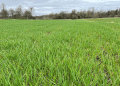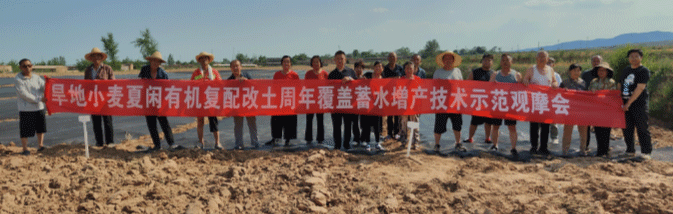
In China’s arid Loess Plateau, where annual rainfall barely reaches 500mm and mostly falls during summer months, Professor Li Tingliang’s team at Shanxi Agricultural University has pioneered a groundbreaking wheat cultivation method. Their integrated approach of organic fertilization + soil moisture conservation + sunshade covering has demonstrated 44% higher yields compared to traditional dryland farming practices.
The Technology Behind the Success
- Organic Soil Amendment
- Special organic compound fertilizer applied post-harvest
- Deep tillage incorporates wheat straw (30cm depth)
- Increases soil organic matter by 1.2% annually
- Rainwater Harvesting System
- Ridge-furrow planting design captures 85% of rainfall
- Sunshade nets reduce evaporation by 40%
- Extends soil moisture retention by 3-4 weeks
- Precision Nutrient Management
- Soil testing formula fertilization before sowing
- Targeted micronutrient supplementation
Yield Performance Comparison
| Location | Traditional Yield (kg/mu) | New Method Yield (kg/mu) | Increase |
|---|---|---|---|
| Demonstration Field | 200 | 288 | 44% |
| Jingnan Region | 240 | 353 | 47% |
| Hongdong County | 210 | 302 | 43.8% |
*(1 mu = 0.067 hectares)*
Scientific Principles at Work
- Rainfall Utilization Efficiency jumps from 20-50% to 65-80%
- Soil Temperature Regulation: Sunshade nets maintain optimal 15-25°C root zone temps
- Microbial Activity: Organic matter boosts beneficial bacteria by 300%
Scaling Up the Solution
The research team is now:
- Establishing 100-acre demonstration plots in Hongdong County
- Training 500+ farmers in the new techniques
- Developing low-cost biodegradable shade materials
“These methods provide scientific support for ensuring food security in arid regions,” emphasized Professor Li, noting the technology’s potential across China’s 13 million hectares of dryland wheat fields.
A Blueprint for Arid-Region Agriculture
This Shanxi model demonstrates how integrating:
- Traditional organic practices with modern materials science
- Precision water harvesting with soil health management
- Farmer-friendly technologies with ecological principles
can transform marginal lands into productive wheat fields. As climate change intensifies drought pressures, such innovations will become increasingly vital for global food security.
Error