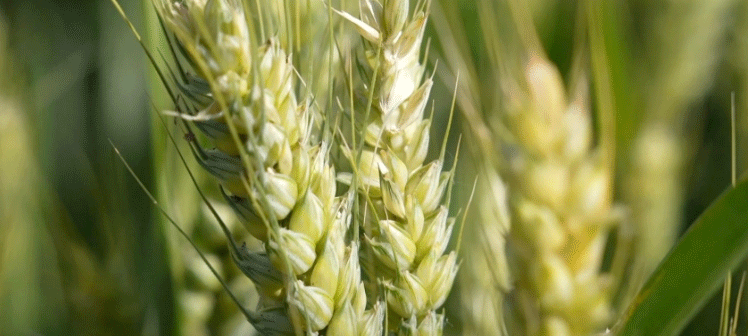
Central China’s Henan Province, often dubbed the “granary of China,” is gearing up for its summer wheat harvest. Over 56,000 square kilometers of wheat fields are set to be reaped, with farmers employing advanced technologies like drones, drip irrigation, and sprinkler systems to optimize water use and maximize yields.
The Stakes: Henan’s Role in China’s Food Security
Henan produces a quarter of China’s wheat, making it indispensable to national food security. However, the province has faced severe drought conditions in recent months, threatening crop productivity. According to the Ministry of Agriculture and Rural Affairs (MARA), prolonged dry spells have affected over 30% of wheat-growing regions, prompting emergency irrigation measures.
Precision Agriculture to the Rescue
To mitigate water scarcity, farmers are adopting precision agriculture tools:
- Drones for aerial monitoring and targeted pesticide/water application.
- Smart irrigation systems (drip and sprinklers) reducing water waste by up to 40% (FAO, 2024).
- Soil moisture sensors enabling real-time adjustments to irrigation schedules.
A 2024 report by the International Food Policy Research Institute (IFPRI) highlights that such technologies can boost wheat yields by 15-20% even under drought stress.
Government Support and Future Challenges
The Chinese government has allocated $1.2 billion in drought relief funds for Henan, focusing on water conservation infrastructure and subsidies for high-efficiency farming equipment. However, climate models predict increasingly erratic rainfall patterns, necessitating long-term adaptation strategies.
Innovation as the Key to Sustainable Harvests
Henan’s 2024 wheat harvest is more than a seasonal event—it’s a proving ground for climate-resilient agriculture. By integrating smart farming practices, the province aims to safeguard its critical role in China’s food supply chain. For farmers and agronomists worldwide, Henan’s experience underscores that technology and proactive water management are no longer optional but essential for future food security.
Error