• About
  • Advertise
  • Careers
  • Contact
Thursday, December 4, 2025
  • Login
No Result
View All Result
Field Crops news
  • Home
  • News
  • AgroTech & Innovation
  • Science
  • Sustainability
  • Market News
  • Research & Development
  • Home
  • News
  • AgroTech & Innovation
  • Science
  • Sustainability
  • Market News
  • Research & Development
No Result
View All Result
Field Crops news
No Result
View All Result
Home Import

China’s Wheat and Barley Imports Surge Amid Domestic Crop Concerns: What It Means for Global Markets

by Tatiana Ivanova
16 May 2025
in Import, News
0
China’s Wheat and Barley Imports Surge Amid Domestic Crop Concerns: What It Means for Global Markets
0
SHARES
7
VIEWS
Share on FacebookShare on Twitter

China’s Rising Wheat and Barley Imports Signal Domestic Production Challenges

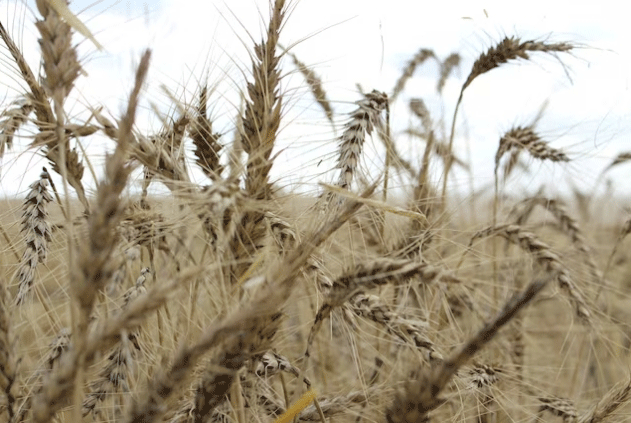
China, the world’s largest wheat producer, has recently ramped up imports from Canada and Australia due to drought concerns in key growing regions. According to traders, Chinese buyers have purchased 400,000 to 500,000 metric tons of milling-quality wheat in recent weeks, with 200,000 tons sourced from Canada and the rest from Australia for July-August deliveries. This marks China’s first major Australian wheat purchase since 2023.

The shift comes as Henan province, responsible for one-third of China’s wheat output, faces potential yield losses due to hot, dry weather. While China maintains substantial wheat reserves—estimated at over 100 million tons—the recent buying spree suggests concerns over domestic supply.

Barley Imports from Ukraine and France

Alongside wheat, China has secured 360,000 to 1 million tons of feed barley, primarily from Ukraine and France, at $250–254 per ton CIF. These purchases highlight China’s strategy to diversify sources amid geopolitical tensions, avoiding U.S. wheat due to trade restrictions.

Global Market Implications

China’s reduced imports earlier in 2024/25 contributed to Chicago wheat futures hovering near four-year lows. However, renewed demand could tighten global supply, especially if weather disruptions persist. Analysts note that while China’s 2025 wheat production may drop by 5 million tons, its massive stockpiles could limit further import surges.

Error

Tags: AgribusinessBarley ImportsChina AgricultureClimate Impactfarm economicsGlobal Grain TradeWheat Market

Tatiana Ivanova

Next Post
Russia’s Wheat Dominance: Record Harvests and Global Market Leadership in 2025/26

Russia’s Wheat Dominance: Record Harvests and Global Market Leadership in 2025/26

Newsletter

Feedgrain Values in South-Eastern Australia Bolstered by Grazier Demand

Feedgrain Values in South-Eastern Australia Bolstered by Grazier Demand

1 July 2024

Wheat in the Balance: Russia’s 2025 Harvest Forecast Rises Amid Threats of Heat and Frost

30 March 2025

AgriLife Extension’s Top Wheat Varieties: Picks for the 2024 Planting Season

7 August 2024

Bashkortostan’s Grain Processing Boom: How Export Growth is Reshaping Regional Agriculture

2 August 2025

From Wheat to Wealth: How Deep Grain Processing is Revolutionizing Agriculture and Industry

30 July 2025

Azerbaijan Expands Agricultural Imports: Russian Wheat and Rice Seeds in Focus

21 September 2024

Chlormequat in Oats: Rising Residue Levels and What Farmers & Agronomists Should Know

13 May 2025

The Rise of “Pure White” Corn: The Sweetest Gem from Hokkaido

3 September 2024

Belarus Nears 9.4 Million Tonne Harvest: A Data-Driven Look at a Diversifying Agrarian Power

13 October 2025

Winter Crop Harvest Sees Optimistic Yields in Bulgaria and Romania

1 July 2024
  • About
  • Advertise
  • Careers
  • Contact
Call us: +51 93 999 5140

© 2020-2024 Field Crops news

Welcome Back!

Login to your account below

Forgotten Password?

Retrieve your password

Please enter your username or email address to reset your password.

Log In
No Result
View All Result
  • Home
  • News
  • Science
  • Sustainability
  • AgroTech & Innovation
  • Market News
  • Science
  • Research & Development
  • About
  • Contact

© 2020-2024 Field Crops news