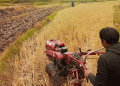

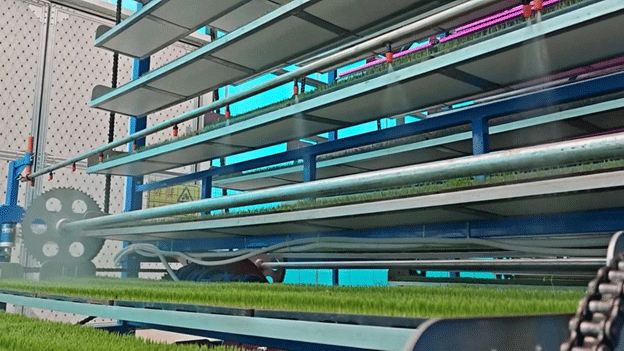
As the world faces increasing pressure to produce more food on less land, farmers in China’s Heilongjiang Province are experimenting with a futuristic solution: miniature Ferris wheel-like structures for growing rice seedlings. At Puyang Farm, these vertical rotating systems are being tested as part of a spring sowing innovation project aimed at increasing efficiency and resilience in rice production.
Each compact vertical unit can hold 4,120 seedling trays, making it possible to produce a large quantity of healthy seedlings in a minimal footprint. According to engineers overseeing the pilot project, this design saves up to 80% of usable land area compared to traditional seedling beds—an enormous advantage in land-scarce or urban-fringe agricultural settings.
Smart Technology Meets Vertical Design
Beyond space-saving benefits, the system’s integration with artificial intelligence (AI) makes it especially powerful:
- 24/7 LED lighting ensures consistent photosynthesis regardless of natural light conditions.
- Automated irrigation and nutrient delivery systems provide optimal moisture and nutrition.
- Temperature and humidity controls are continuously adjusted by AI algorithms, creating ideal conditions for fast, uniform seedling development.
The result? The seedling production cycle is shortened by 5–7 days, giving farmers more flexibility in sowing schedules and better synchronization with field preparation and transplanting activities.
Why It Matters for Global Agriculture
While vertical farming has gained traction for leafy greens and high-value crops, its application to rice—a staple food for over half the world’s population—is groundbreaking. Rice is typically grown in flooded, horizontal seedling beds that require large tracts of land and are vulnerable to climate variability. This vertical seedling approach offers a controlled, weather-independent alternative that could be a game changer for rice production in regions with:
- Unpredictable weather patterns
- Limited arable land
- High labor and input costs
The Heilongjiang project is already drawing attention from researchers and policymakers across Asia, particularly in countries like Vietnam, India, Indonesia, and Bangladesh, where rice farming is both economically vital and increasingly challenged by climate change and land degradation.
Looking Ahead
If widely adopted, this vertical rice seedling method could pave the way for:
- Decentralized seedling production units in peri-urban areas or near transplant sites
- Year-round propagation regardless of seasonality
- Reduced labor dependency due to automation
- Lower land-use intensity, contributing to environmental sustainability
The Ferris wheel-style seedling system being tested in China may seem like science fiction, but it reflects a real and pressing need to rethink staple crop production in the face of land scarcity and climate uncertainty. As vertical farming technology expands into the realm of grains, the future of rice farming could be smarter, faster, and far more space-efficient than ever imagined.
Error