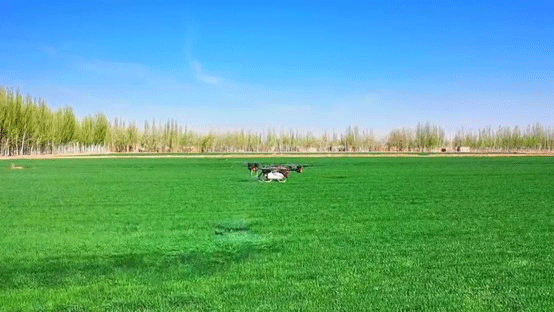
Spring has arrived on the fields of Keping County in southern Xinjiang, and with it comes one of the most decisive moments in the wheat production cycle: the heading stage. At this key time, crops are particularly vulnerable to wheat rust and aphid infestations, both of which can severely impact yield. But this year, something different is happening in the skies above the wheat fields—drones are flying to the rescue.
In the village of Yusutun Kashairike, Gaziirik Town, thousands of mu of winter wheat are being treated not by human hands, but by plant protection drones (PPDs) operated by trained technicians. With a soft buzz, the drones rise, navigating with Beidou satellite precision, and release a fine mist of protective sprays that fall evenly across the lush, green rows of wheat.
According to Xu Hui, agricultural science and technology coordinator for the village, 1,250 mu (≈83 hectares) of winter wheat were planted this year. As of early April, drones had completed treatment on 80% of the land, and the results are promising.
Compared to traditional manual spraying:
- One drone can cover 800–1000 mu per day—that’s 20 times faster than manual labor.
- Labor costs are reduced by more than 30 yuan per mu, a significant savings for farmers.
- Drones reduce crop damage from trampling, while improving accuracy and uniformity of spray application.
- Precision spraying helps prevent uneven chemical distribution, which can lead to ineffective pest control or crop damage.
Most importantly, early results suggest that pest and disease control is significantly more effective, reducing the risk of rust and aphid damage during this vulnerable growth period. According to the Ministry of Agriculture and Rural Affairs, wheat rust losses can range from 10% to 70% in affected areas without timely management. Drones are quickly becoming a first line of defense.
The adoption of drone technology is part of a broader agricultural modernization strategy in Keping County. The local government has heavily invested in:
- High-standard farmland development
- Mechanized sowing and harvesting
- Digital crop monitoring
- Training programs for drone operation and maintenance
These efforts are transforming agriculture into a more tech-driven, efficient, and sustainable system, with the goal of increasing yields, reducing inputs, and improving rural incomes. Keping’s drone operations are part of the region’s broader “technology empowers agriculture” campaign, which aligns with China’s national rural revitalization strategy.
According to Deputy Town Mayor Yusufu Keremu, the use of drones is only the beginning. “In the future, we’ll continue integrating smart technologies into our agricultural development plan—using UAVs, data systems, and mechanization to build a higher quality, more efficient agricultural economy.”
Keping County’s embrace of drone-based plant protection marks a major step toward agricultural modernization. By combining speed, accuracy, and cost-effectiveness, drones are helping farmers control threats, increase yields, and safeguard their wheat crops—all while laying the foundation for smarter farming systems. As more rural communities adopt these tools, the future of agriculture in China looks increasingly airborne—and intelligent.
Error