In the heart of southern Xinjiang, China’s vast desert-framed farmlands are undergoing a quiet but profound revolution. With the retirement of Xindong 20, a winter wheat variety that has fed millions since 1998, a new generation—Xindong 60—is taking the lead. This variety, cultivated and refined over 20 years, represents the forefront of China’s push toward modern, high-efficiency agriculture.
Xindong 20 wasn’t just a wheat variety—it was a lifeline. Developed by introducing early-maturing lines from Hebei Province and refining them locally, this variety overcame the region’s arid and diverse ecological challenges. With yields rising from 300 to over 450 kg/mu (equivalent to 6.75 t/ha), it not only fed communities but also freed land for higher-value crops like cotton. Its drought resistance, early maturity, and stable performance made it a staple across southern Xinjiang.
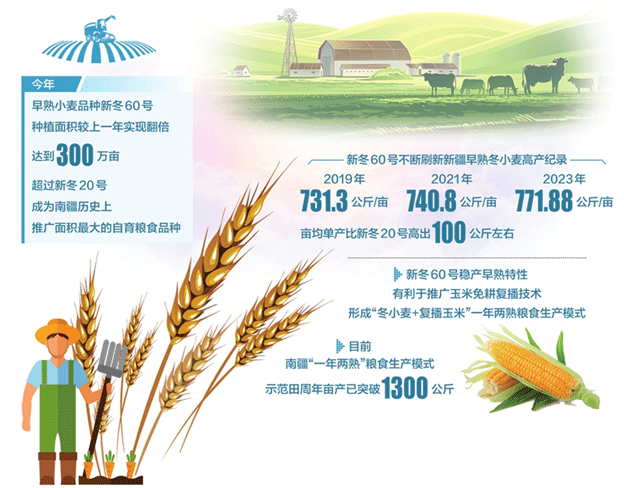
But with growing demands for both yield and grain quality, the region needed more. That’s where Xindong 60 came in. Bred entirely in Xinjiang and officially introduced in 2016 after two decades of research, it has rapidly gained momentum—reaching 3 million mu of cultivated area in 2025, doubling from the year before and surpassing its predecessor. This makes it the largest self-developed food crop variety ever promoted in southern Xinjiang.
And the performance speaks for itself. In trial fields, Xindong 60 smashed records with yields of:
- 731.3 kg/mu (2019)
- 740.8 kg/mu (2021)
- 771.88 kg/mu (2023)
—averaging over 100 kg/mu higher than Xindong 20. These results convert to over 11.5 t/ha, setting new regional benchmarks for early-maturing winter wheat. Moreover, it meets the medium-gluten wheat standard, giving a much-needed boost to Xinjiang’s growing flour and food processing industries.
This transformation didn’t happen overnight. Farmers initially hesitated—familiar with old varieties and skeptical of new ones. As one local farmer, Aihemati Maimaiti, put it: “Old varieties feel safe—what if the new ones don’t work?” This common concern highlights a broader truth: successful varietal replacement requires more than superior genetics. It needs trust, support, and a coordinated system.
Xinjiang responded with a “breeding–multiplication–extension” integration strategy, supported by joint efforts from the Xinjiang Academy of Agricultural Sciences, seed companies like Jiufenghe Seed Co., and local agricultural departments. Demonstration plots, hands-on training, and adaptive cultivation techniques helped bridge the gap between experimental fields and real farms.
One particularly impactful innovation has been the integration of no-till maize relay cropping. By planting maize directly after wheat harvest without plowing and combining this with drip irrigation, farmers can start maize 10 days earlier, improving heat resource utilization by 10%. This approach has pushed combined annual yields (wheat + maize) past 1300 kg/mu (~19.5 t/ha), transforming southern Xinjiang into a true two-season grain powerhouse.
The synergy between Xindong 60 and this system is game-changing. Its early maturity and stable performance allow farmers to time maize planting perfectly. This not only raises yields but also boosts land-use efficiency, water savings, and crop quality—a vital move as China pushes to enhance its national grain output and secure food sovereignty.
According to China’s National Bureau of Statistics, Xinjiang contributed nearly 6 million tons of wheat in 2023, with production climbing steadily thanks to yield improvements and innovations like Xindong 60. With plans to make Xinjiang a key national base for high-quality agri-products, this varietal upgrade is a cornerstone of long-term strategy.
The transition from Xindong 20 to Xindong 60 is more than a varietal upgrade—it’s a model for modern agricultural innovation. By combining strong genetics, adaptive technology, enterprise-science cooperation, and farmer education, Xinjiang has shown how to increase yields, stabilize incomes, and protect national food security. As Xindong 60 takes root, its legacy will not just be measured in harvests, but in how it reshaped the future of grain farming in China.
Error