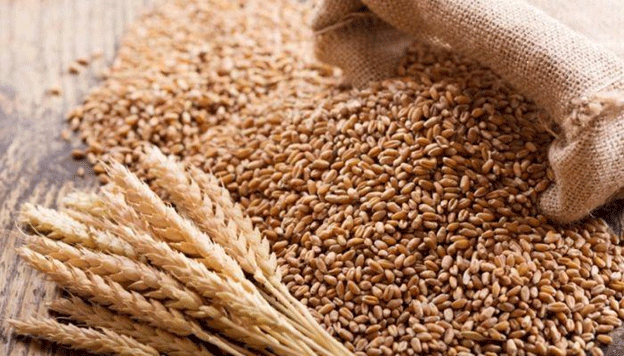
In a significant move to support wheat production in Nigeria, the Federal Government has launched the distribution of subsidized inputs to around 6,000 wheat farmers in Kano State. The initiative aims to alleviate the financial burden on farmers, boost wheat yields, and reduce the country’s reliance on imported wheat.
The program was officially launched by Abubakar Kyari, the Minister of Agriculture and Food Security, through his representative, Isa Hotoro, the State Coordinator of the Ministry of Agriculture and Food Security. The distribution event took place on Thursday at the Aggregation Centre in Alkamawa Village, Bunkure Local Government Area (LGA).
Subsidy Details and Expected Impact
The government is offering a 75% subsidy on farming inputs, with the remaining 25% to be covered by the farmers themselves. This subsidy package includes three bags of fertilizer and one bag of 50kg wheat seeds for each farmer, valued at N111,000 (representing 25% of the total package cost). This initiative is part of a special program aimed at increasing wheat production across the country, particularly in regions such as Kano, which is a key wheat-growing state.
According to the Minister, the goal is to help farmers cultivate 3,000 hectares of farmland across 12 special clusters in the Alkamawa, Ajingi, and Gaya LGAs of Kano State. Each farmer is expected to cultivate 0.5 hectares in these designated clusters, making the program highly targeted and organized.
Farmers’ Perspectives and Support for the Initiative
The response from local farmers has been largely positive. Yakubu Ibrahim, one of the farmers, shared his experience, explaining that the high costs of inputs and transportation had previously forced him to reduce his cultivated land area from five hectares to two hectares. With the help of the subsidized inputs, farmers like Ibrahim are now able to expand their operations, contributing to the government’s goal of increasing domestic wheat production.
However, farmers have urged the government to ensure timely distribution of the inputs to allow adequate preparation ahead of the planting season. Delays in input supply could impact crop yields and undermine the effectiveness of the program.
Wider Agricultural Implications
This initiative is part of a larger effort to reduce Nigeria’s reliance on imported wheat, a crop for which the country has faced significant import bills. The subsidy program is expected to not only reduce input costs but also increase wheat production, contributing to the country’s food security and economic stability.
A Step Towards Self-Sufficiency in Wheat Production
The Federal Government’s subsidized input program represents a major step in Nigeria’s efforts to boost local wheat production. By providing financial relief to wheat farmers, the government is addressing the high costs that have limited agricultural expansion in the country. With continued support and timely distribution of inputs, the wheat sector in Kano State and beyond has the potential to grow, contributing to greater food security and reduced dependence on wheat imports.
Error