
Shandong Province, known as China’s agricultural powerhouse, holds a vital role in the nation’s food security. The province is renowned for its high grain yield, both in total volume and per unit area, consistently ranking among the highest in the country. In May this year, President Xi Jinping visited Shandong and emphasized the importance of high-standard farmland development to enhance grain productivity and quality, aiming to build a more advanced “Qilu Granary.” Shandong has committed to this vision by undertaking comprehensive initiatives that integrate advanced agricultural practices and cutting-edge technology.
Pioneering High-Standard Farmland
Shandong has made remarkable strides in constructing high-standard farmland. By the end of 2024, Shandong had developed 76.4 million mu (approximately 5.1 million hectares) of high-standard farmland, accounting for 80% of the province’s total arable land and 90% of its permanent basic farmland. This effort has resulted in an average increase in grain yield per mu by 10% to 20% compared to pre-construction figures. The fields are not just improved structurally but equipped with irrigation and drainage systems that optimize water and nutrient use, promoting crop health and resilience.
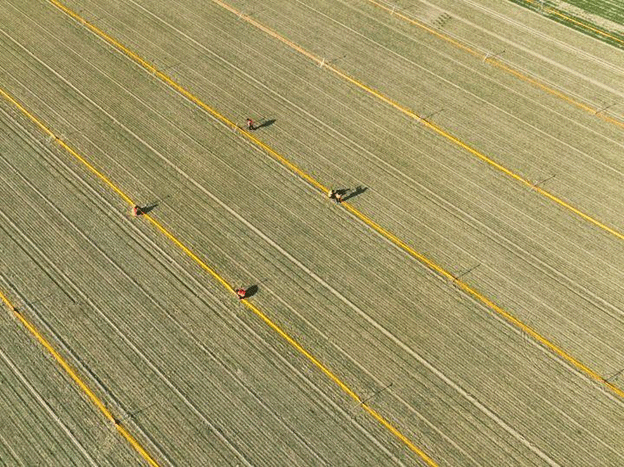
The transformation is evident in Jining’s Jiaxiang County, where advanced tractors equipped with the Beidou Navigation System automate tasks such as tilling, sowing, and fertilizing. “These machines can automatically plan seeding paths,” explains Shan Wanmin, director of Wanmin Agricultural Service Center. By spring, the wheat rows emerge uniformly, showcasing the efficiency of smart farming equipment.
Embracing Smart Agriculture
Shandong’s transition from traditional to smart agriculture has been swift. In Weifang’s Weichai Lovol Smart Agriculture Demonstration Base, over 40 intelligent machines operate autonomously, handling everything from harvesting to soil monitoring. Driverless harvesters avoid obstacles and collect real-time data on soil quality and crop conditions, while advanced planters can sow soybeans and corn simultaneously to maximize land productivity.
During the critical autumn harvest season, approximately 2.1 million agricultural machines, including 9,500 units equipped with automatic guidance systems, were deployed across the province. These innovations have proven crucial, particularly in regions like Jining’s Wenshang County, which faced severe drought. By mobilizing over 8,000 units of large-scale irrigation equipment through agricultural cooperatives, the county effectively protected the crops from wilting, underscoring the resilience of precision irrigation systems.
The Role of High-Performance Seeds and Techniques
The impact of high-yield seed varieties cannot be overstated. Shandong’s success with wheat production is exemplified by the widespread adoption of “Luyan 951,” a resilient variety known for disease resistance and high yield potential. This year alone, the seed’s planting area reached 1.5 million mu, with some fields achieving yields of 864 kilograms per mu. Four of the top ten wheat varieties nationwide originate from Shandong, covering over half of the province’s wheat acreage.
Moreover, Shandong has been a leader in promoting integrated crop management practices. Techniques such as precision sowing, dense planting, and targeted irrigation have improved productivity while conserving resources. For example, in Yucheng, cooperative farms have adopted a combined strategy of herbicide selection and late-sowing practices, achieving optimal growth conditions for both corn and soybeans. The emphasis on efficient planting methods has enabled continuous yield improvements and balanced crop management.
Taming the Saline-Alkali Soils
One of Shandong’s most impressive achievements has been the transformation of saline-alkali soils into productive farmland. With nearly 9 million mu of such land in the province, local governments and researchers have developed a range of soil improvement technologies. In Weifang, integrated soil remediation and salt-resistant crop varieties have significantly reduced soil salinity, boosting grain output. The recent success in Dongying’s Huibang Bohai Farm, where corn yields reached 648.4 kilograms per mu on saline land, highlights the effectiveness of these methods.
The introduction of high-yield, salt-tolerant crops has also revolutionized agriculture in the Yellow River Delta. For instance, innovative planting techniques like subsurface drainage and fertigation systems have transformed previously barren fields into fertile farmland capable of supporting high-yield rice and wheat crops.
Reducing Post-Harvest Losses
Beyond fieldwork, Shandong has excelled in minimizing post-harvest losses. The province has invested heavily in grain storage and processing infrastructure. As of 2024, the average wheat harvesting loss rate in Shandong was reduced to 0.81%, a significant drop from previous years. Facilities like the 5.1-million-ton storage center in Dezhou’s Yucheng Township ensure that harvested crops are efficiently processed, dried, and stored, protecting them from pests and spoilage.