
• About
  • Advertise
  • Careers
  • Contact
Friday, December 5, 2025
  • Login
No Result
View All Result
Field Crops news
  • Home
  • News
  • AgroTech & Innovation
  • Science
  • Sustainability
  • Market News
  • Research & Development
  • Home
  • News
  • AgroTech & Innovation
  • Science
  • Sustainability
  • Market News
  • Research & Development
No Result
View All Result
Field Crops news
No Result
View All Result
Home News

Disillusionment Post-International Year of Millets: Why Farmers Are Shifting Away from Coarse Grains

by Tatiana Ivanova
1 August 2024
in News
0
Disillusionment Post-International Year of Millets: Why Farmers Are Shifting Away from Coarse Grains
0
SHARES
3
VIEWS
Share on FacebookShare on Twitter

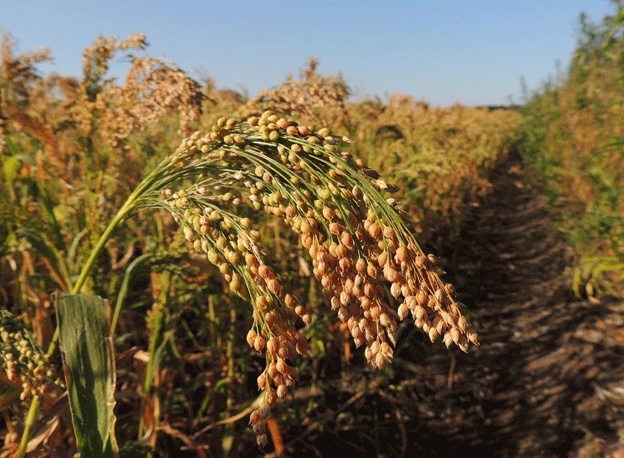
The International Year of Millets (2023) was marked by extensive promotional activities and significant investment, aimed at boosting the cultivation of coarse grains such as millet. However, as the year concluded, the enthusiasm appears to have waned, with a notable decrease in the area under millet cultivation in 2024. According to recent reports from the Ministry of Agriculture, the area under coarse grains has dropped by a record 1.12 million hectares compared to the previous year.

Challenges Faced by Farmers

Despite the high-profile celebrations and substantial budget allocations for promoting millets, the benefits have not trickled down to farmers. The central issue lies in the lack of a robust procurement mechanism. For example, in Rajasthan, the leading millet-producing state, not a single grain of millet was purchased at the Minimum Support Price (MSP). This has forced farmers to sell their produce at lower prices in the open market, undermining the incentive to grow millets.

Current Statistics and Market Prices

As of July 19, 2024, the area under millet cultivation stands at 1.2372 million hectares, down from 1.3491 million hectares at the same time last year. Specifically, the area under pearl millet (bajra) has decreased by 1.59 million hectares. The MSP for millet is set at ₹2,500 per quintal for the 2023-24 marketing season, but farmers are only receiving around ₹2,193.56 per quintal in the open market, which is lower than the previous year’s average of ₹2,211.28 per quintal.

Government’s Role and Farmers’ Concerns

The government’s focus during the International Year of Millets was primarily on consumer awareness and global promotion, rather than on ensuring that farmers benefited directly from these initiatives. The lack of a guaranteed procurement system means that while the celebrations continued, the core issues affecting farmers—such as price security and market access—remained unaddressed.

Farmers argue that without a substantial change in procurement policies and a commitment to purchase at MSP or higher prices, the area under millet cultivation will continue to shrink. The celebrations and international recognition have done little to alter the economic realities faced by those growing these crops.

The International Year of Millets aimed to spotlight the benefits of coarse grains and boost their cultivation. However, without effective procurement policies and price guarantees, the enthusiasm has not translated into tangible benefits for farmers. The current drop in millet cultivation highlights the urgent need for systemic changes to ensure that the promotion of millets results in real, sustainable support for the farming community.

Error

Tags: agricultural policyCoarse GrainsFarmer supportIndia AgricultureInternational Year of MilletsMarket PricesMillet CultivationMillet PromotionMSPRajasthan Millet Production

Tatiana Ivanova

Next Post
Promoting Buckwheat: The 2024 China Kangbao Buckwheat Industry Season and Third “Lover’s Flower” Cultural and Ecological Tourism Carnival

Promoting Buckwheat: The 2024 China Kangbao Buckwheat Industry Season and Third "Lover's Flower" Cultural and Ecological Tourism Carnival

Newsletter

The Profitability Paradox: Record Yields, Plummeting Prices, and the Squeeze on the Modern Farmer

The Profitability Paradox: Record Yields, Plummeting Prices, and the Squeeze on the Modern Farmer

28 September 2025

Untangling the Hormonal Web: How Strigolactone Insensitivity Reshapes Barley Architecture

21 April 2025

Black Wheat: The Rising Star of Sustainable Agriculture and Rural Prosperity

15 July 2025

Turkey Emerges as Leading Buyer of Russian Grain Despite a 30% Drop in Purchases

16 July 2024

Cover crops: benefits to a rotation (part I)

13 June 2024

Russian Legume Production Set to Increase in 2024 Despite Challenging Weather Conditions

22 October 2024

Homegrown Breakthrough: New Oat Varieties Boost Key Traits by 30%, Challenging Import Dependence

21 November 2025

Belarus Nears 9.4 Million Tonne Harvest: A Data-Driven Look at a Diversifying Agrarian Power

13 October 2025

Optimism Returns to Canadian Prairies as Weather Conditions Improve

9 July 2024

Record Wheat Harvest in Langfang: How Modern Farming Techniques Boost Yields and Efficiency

22 June 2025
  • About
  • Advertise
  • Careers
  • Contact
Call us: +51 93 999 5140

© 2020-2024 Field Crops news

Welcome Back!

Login to your account below

Forgotten Password?

Retrieve your password

Please enter your username or email address to reset your password.

Log In
No Result
View All Result
  • Home
  • News
  • Science
  • Sustainability
  • AgroTech & Innovation
  • Market News
  • Science
  • Research & Development
  • About
  • Contact

© 2020-2024 Field Crops news