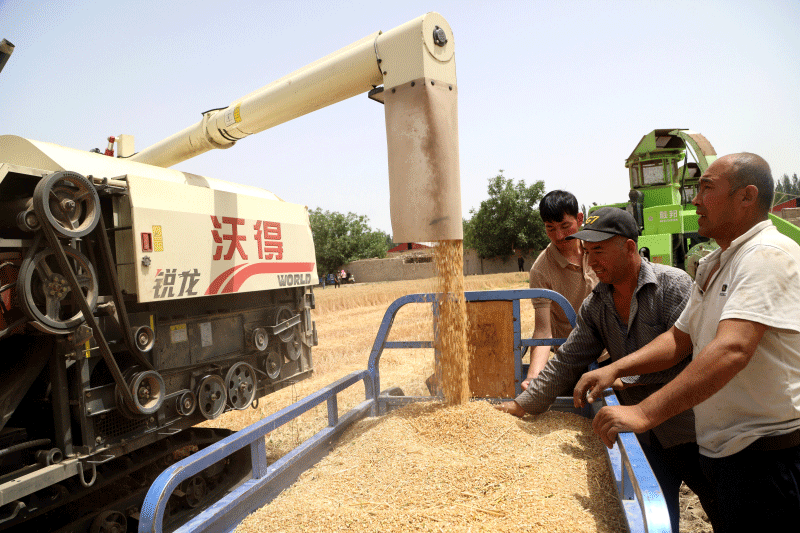
As the golden waves of wheat sway in the summer breeze, Shache County in Xinjiang has officially entered the harvest season for its 74.3 million mu (approx. 49,533 hectares) of winter wheat. The county is utilizing advanced agricultural machinery, including combine harvesters, to ensure a swift and efficient harvest while minimizing labor costs.
Mechanization Drives Productivity
Farmers in Shache County, such as Mieradil Mutellip from Baghawat Township, report significant benefits from mechanization. His 15 mu (1 hectare) of wheat is expected to yield over 600 kg/mu (approx. 9,000 kg/ha), thanks to full mechanization—from planting to harvesting. The use of combine harvesters not only speeds up the process but also reduces labor costs by 30-50%, according to recent studies on mechanized farming in China (National Agricultural Mechanization Development Report, 2023).
High-Yield Varieties Ensure Stable Production
The county has adopted high-yield wheat varieties such as Xindong 60, Zhongmai 578, and Jingmai 189, which offer better disease resistance and higher grain weight. According to Zhu Minghui, an agronomist from the Kashgar Agricultural Technology Extension Center, Zhongmai 578 can achieve 52 grams per thousand grains under optimal conditions, contributing to stable yields.
Globally, the adoption of high-yield wheat varieties has increased average productivity by 15-20% (FAO, 2024). In Shache County, the expected yield is 695 kg/mu (10,425 kg/ha), surpassing the national average of 5,800 kg/ha (China Agricultural Statistical Yearbook, 2023).
Government Support and Future Outlook
The local government has prioritized food security by promoting high-standard farmland construction and precision agriculture techniques. With 5 harvesters deployed in Baghawat Township alone, the county aims to complete harvesting by late June, followed by immediate replanting for double-cropping systems.
Shache County’s success in wheat production highlights the critical role of mechanization, high-yield varieties, and government support in modern agriculture. As global demand for food rises, such models can serve as blueprints for sustainable and efficient farming practices worldwide.
Error