
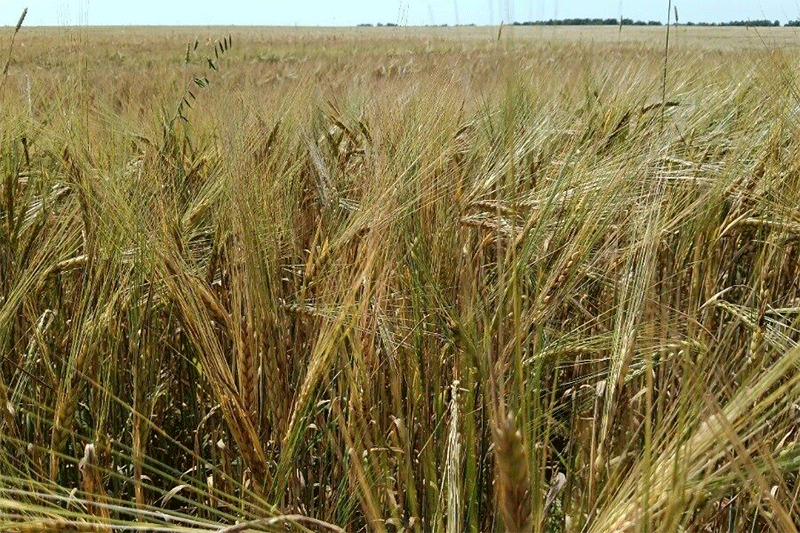
For farmers, agronomists, and grain handlers in Novosibirsk and across Siberia, the summer of 2023 has presented a familiar adversary: prolonged rainfall during the critical harvest period. As reported, August rains have jeopardized grain quality, evoking concerns of a repeat of the 2022 season where significant portions of the harvest were downgraded to feed grain due to pre-harvest sprouting.
The Agronomic Threat: Pre-Harvest Sprouting and Quality Degradation
The primary concern, as highlighted by Sergei Sokolov of “Novosibirskhleboprodukt,” is pre-harvest sprouting (PHS). This occurs when prolonged moisture and humidity trigger the germination process in mature grain while it’s still standing in the field. The enzymatic activity associated with sprouting breaks down starch and protein, directly attacking two key quality parameters: falling number and gluten quality.
A 2022 study in the journal Agriculture underscores the severity of this issue, finding that just 60 hours of consistent rain and high humidity at grain maturity can cause the falling number—a critical indicator of sprout damage—to plummet from over 350 seconds to below 200 seconds, effectively downgrading milling wheat to feed quality. This aligns precisely with the described scenario from last year, where Class 3 wheat fell to Class 5. While the region has narrowly avoided catastrophic damage so far, the threat remains palpable with any further September precipitation.
Beyond Sprouting: The Cumulative Impact of a Cool, Wet Season
Mr. Sokolov also points to another quality concern: lower gluten content due to a cooler summer. This is supported by agronomic models showing that protein accumulation in wheat is highly dependent on nitrogen availability and uptake, which is hampered in waterlogged soils, and on temperature during grain filling. A cool, wet season often leads to higher yields but with diluted protein content. Data from the Global Wheat Network indicates that for every 1°C decrease in average temperature during the grain-filling period, protein content can decrease by approximately 0.5-1%. This creates a double-edged sword for farmers: potentially salvaging a high-yield crop that fails to meet premium quality specifications.
The Economic Squeeze: Low Prices Compound Quality Anxiety
The potential for quality loss is exacerbated by a dire economic reality: persistently low farmgate prices. Reports from the Russian Institute for Agricultural Market Studies (IKAR) show that export prices and domestic prices in Siberian regions have been under pressure due to logistical constraints and large national harvests. When farmers state that current prices are “half the cost of production,” the strategic calculus changes entirely.
Facing the prospect of selling a compromised crop at a loss, the logical response for many is to invest in storage. On-farm storage allows farmers to become market speculators, holding grain off the market in anticipation of better prices later in the season. However, this strategy is not without risk. Storing grain that has been harvested at a higher moisture content or with potential latent damage from field molds requires sophisticated drying and aeration infrastructure to prevent further quality deterioration in the bin, turning a marketing decision into a significant post-harvest management challenge.
The situation in Novosibirsk is a stark reminder of the profound vulnerability of agriculture to weather volatility. The 2023 harvest hangs in a delicate balance, saved from immediate ruin by a break in the rain but still at the mercy of September’s weather. The combination of quality threats from pre-harvest sprouting and low protein, compounded by unfavorable economics, forces farmers into a defensive posture. The key strategies for navigating this season will be:
- Vigilant Monitoring: Conducting pre-harvest tests for falling number and protein to accurately assess quality before sale or storage.
- Investment in Post-Harvest Infrastructure: Leveraging proper drying and storage facilities to preserve existing quality and enable strategic grain holding.
- Market Intelligence: Making informed decisions based on local and global price trends to determine the optimal time to sell stored grain.
Ultimately, resilience in modern agriculture requires not just agronomic expertise but also robust risk management and market strategy.
Error