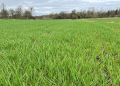
Tanzania’s agricultural sector is grappling with significant challenges in meeting the demand for edible oil and wheat due to low local production and disruptions in supply chains. Annually, Tanzania consumes around 650,000 metric tons (MT) of edible oil, but local production only reaches 290,000 MT. This shortfall has led the country to rely heavily on imports, exacerbating vulnerability to international market fluctuations. Similarly, wheat production stands at 93,000 MT annually, with demand far exceeding local output, prompting substantial imports.
To address these gaps, USAID/Tanzania has awarded AGRA a $3.0 million grant for the Emergency Deployment of Sunflower and Wheat Seed project (EDSW). This initiative, spanning 36 months from January 1, 2023, to December 31, 2025, aims to boost local production, enhance seed availability, and support resilience to global supply shocks. “The project is crucial for stabilizing the domestic market and ensuring food security,” says Dr. John Bosco, USAID/Tanzania’s Agricultural Development Advisor. “By increasing local production, we reduce our dependence on imports and improve farmers’ incomes.”
One of the main challenges in Tanzania’s sunflower and wheat sectors is the use of outdated agricultural resources. Many smallholder farmers rely on more than 30-year-old open-pollinated varieties of sunflower and recycled wheat seed, which severely limits genetic diversity, making crops more susceptible to diseases and pests. As a result, yields remain low, averaging just 50,400 MT for sunflower and 93,000 MT for wheat annually. The USAID project seeks to reverse this trend by increasing production to 1.2 million MT of sunflower and 416,000 MT of wheat through enhanced seed systems and advanced farming techniques.
The EDSW project focuses on improving access to high-quality seeds, integrating better agronomic practices, and supporting smallholder farmers with extension services. “The project is not just about providing seeds; it’s about creating a sustainable, market-driven system,” says Dr. Bosco. “By engaging major processors and seed producers, we aim to significantly increase the supply of sunflower and wheat seeds—from 1,500 MT to 5,000 MT for sunflower and 1,000 MT to 4,000 MT for wheat annually.” This increase will help ensure that farmers have access to the necessary resources to achieve higher yields and reduce their reliance on older, less effective seed varieties.
An integrated approach is being employed in the EDSW project, with a focus on market-driven solutions and collaboration with key stakeholders. “We are working closely with processors, seed producers, and agricultural extension agents to disseminate knowledge and support the adoption of improved seeds,” says Dr. Bosco. This approach also involves the production and distribution of certified seeds, making high-yielding sunflower and wheat varieties more accessible to smallholder farmers. Additionally, the project aims to commercialize four new seed varieties, thereby broadening the range of options available to farmers and improving their resilience to changing climate conditions.
The success of the EDSW project will depend on the ability to build an efficient seed system that can sustain increased production. This system will be supported by the establishment of a robust seed production infrastructure, the scaling of early generation seed production, and the enhancement of seed distribution networks. “We are looking at ways to scale production across the value chain—from seed multiplication to distribution—so that we can meet the increased demand for high-quality seeds,” explains Dr. Bosco. “By improving access to these seeds, we not only boost production but also empower farmers to adopt better agricultural practices.”
The USAID Emergency Deployment of Sunflower and Wheat Seed project represents a significant step forward for Tanzania’s agricultural sector. By investing in seed systems and engaging with key players across the value chain, the project aims to significantly increase local production of sunflower and wheat. This will not only reduce dependency on imports but also enhance food security and economic stability for smallholder farmers in the country. The integration of market-driven solutions and extension services is crucial to the long-term sustainability of these efforts, ensuring that Tanzania’s agricultural sector can withstand future shocks.
Error