• About
  • Advertise
  • Careers
  • Contact
Saturday, December 13, 2025
  • Login
No Result
View All Result
Field Crops news
  • Home
  • News
  • AgroTech & Innovation
  • Science
  • Sustainability
  • Market News
  • Research & Development
  • Home
  • News
  • AgroTech & Innovation
  • Science
  • Sustainability
  • Market News
  • Research & Development
No Result
View All Result
Field Crops news
No Result
View All Result
Home Climate

Unseasonably Warm Weather Threatens Russia’s Wheat Harvest in 2025

by Tatiana Ivanova
26 January 2025
in Climate, Harvest, News
0
Unseasonably Warm Weather Threatens Russia’s Wheat Harvest in 2025
0
SHARES
7
VIEWS
Share on FacebookShare on Twitter

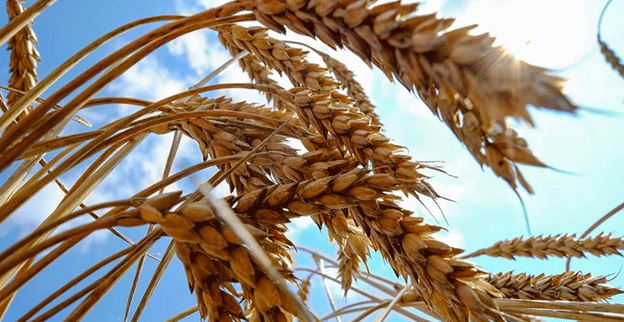
Russia, the world’s largest wheat exporter, faces a significant challenge in 2025 as wheat production is projected to drop to 78.7 million metric tons, according to SovEcon. This decline, compared to 82.4 million metric tons in 2024, is attributed to unseasonably warm weather across key agricultural regions.

The unusually high temperatures have drastically reduced snow cover in central and southern Russia, leaving wheat crops vulnerable. Snow acts as a natural insulator, protecting winter wheat from extreme temperature fluctuations. In the Volga region, snow levels remain relatively normal, but elsewhere, the lack of adequate snow cover could accelerate wheat’s growth cycle prematurely. This premature vegetative development increases the crop’s sensitivity to potential frost damage should cold temperatures return.

Another threat to the wheat crop is the formation of ice crusts, a phenomenon becoming more frequent in recent years. Ice crusts form when melted snow refreezes, creating a solid layer of ice that hinders oxygen access and root development in winter wheat. This condition, already observed in affected regions, can lead to significant crop losses.

Warm weather also creates favorable conditions for pests and plant diseases to thrive. Without the natural pest control provided by cold winters, farmers may face increased infestations and disease outbreaks, further reducing yields. In November, SovEcon reported that 37% of the wheat crop was already in poor condition, raising alarms for the coming season.

Broader Implications

The anticipated production decline could affect global wheat markets, given Russia’s key role as a wheat exporter. Lower yields may lead to higher domestic prices, tighter global supplies, and increased food security concerns in wheat-importing nations. Additionally, persistent climate anomalies like those observed in Russia highlight the broader challenges of adapting agriculture to a changing climate.

The forecasted decline in Russia’s wheat production underscores the vulnerability of agriculture to climate anomalies. Farmers, agronomists, and policymakers must collaborate on strategies to mitigate these risks. Investments in crop breeding for resilience, improved forecasting tools, and sustainable farming practices will be critical to safeguarding future harvests in the face of climate variability.


Error
Tags: 2025 wheat forecastclimate change impactsfrost damageice crustspestsRussian Agriculturesnow coverSovEconWheat productionwinter wheat

Tatiana Ivanova

Next Post
Maximizing Wheat and Soybean Yields: The Power of New Varieties “Ermolovka,” “Sistema,” and “Teiri

Maximizing Wheat and Soybean Yields: The Power of New Varieties "Ermolovka," "Sistema," and "Teiri

Newsletter

Advancing Environmental Sustainability in Canadian Agriculture: A Comprehensive Overview

Advancing Environmental Sustainability in Canadian Agriculture: A Comprehensive Overview

4 July 2024

Perm Krai Exports First Batch of Wheat Seeds to Mongolia

3 March 2025

The ABCD of Global Grain Trade: How Four Giants Shape the Market and What It Means for Farmers and Consumers

19 December 2024

Australia’s Wheat Promise Falters: Drought Threatens a Record Harvest and Global Supply

20 October 2025

Russia’s Grain Exports to Africa Surge by 45% Through Krasnodar Ports

24 February 2025

Boosting Agricultural Efficiency: New Machinery Delivered to Rural Areas in Rio Grande do Sul

9 July 2024

Russian Wheat Export Prices Continue to Decline in July

7 July 2024

When a Billion in Revenue Isn’t Enough: A Cautionary Tale of Agri-Trade Bankruptcy and Counterparty Risk

3 September 2025

Omsk Region’s Remarkable Grain Harvest: A Surge in Yields for 2024

11 October 2024

Iran’s Feed Crisis: How Russian and Kazakh Exports Are Filling a 15 Million Ton Demand Gap

5 September 2025
  • About
  • Advertise
  • Careers
  • Contact
Call us: +51 93 999 5140

© 2020-2024 Field Crops news

Welcome Back!

Login to your account below

Forgotten Password?

Retrieve your password

Please enter your username or email address to reset your password.

Log In
No Result
View All Result
  • Home
  • News
  • Science
  • Sustainability
  • AgroTech & Innovation
  • Market News
  • Science
  • Research & Development
  • About
  • Contact

© 2020-2024 Field Crops news