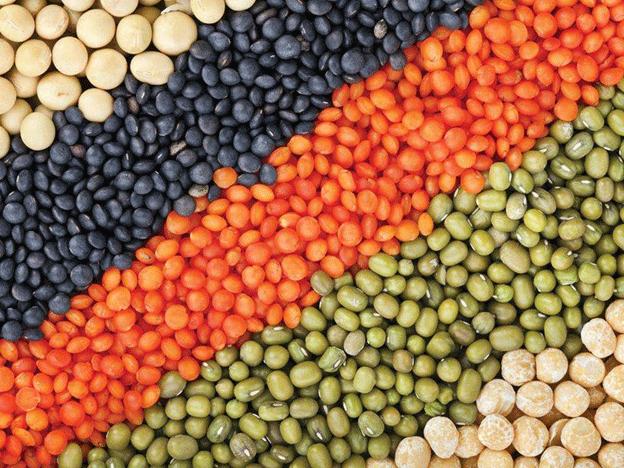
Turkey continues to strengthen its position as a leading exporter in the global agricultural market. In the first half of the year, the grain, pulses, oilseeds, and related products sector saw exports rise by 6.9%, totaling $5.9 billion. This significant growth is underpinned by robust production, strategic trade policies, and a diversified export portfolio that includes high-value products such as biscuits, vegetable oils, wheat flour, and pasta.
Impressive Export Growth
According to the Turkish Food Exporters Association (TGİ), the sector’s export volume increased by 25%, reaching 6.2 million tons. Key export destinations included Iraq, the United States, and Syria. Notably, revenue from exports to Iraq surged by 10.7% to $1.068 billion, while sales to the US and Syria amounted to $316.1 million and $251.3 million, respectively.
The breakdown of product exports highlights the sector’s diversity:
- Biscuits and pastries: $811 million
- Vegetable oils: $696 million
- Wheat flour: $675 million
Strategic Trade Policies and Global Impact
Ahmet Tiryakioğlu, President of the TİM Grain, Pulses, Oil Seeds, and Products Sector Board, emphasized Turkey’s balanced trade policies amid fluctuating global market conditions. He noted that increased rainfall and high production expectations in major producing countries like Russia and the US have led to softened grain prices globally. Turkey’s ban on wheat imports has also played a role in maintaining lower domestic prices. Tiryakioğlu pointed out that lifting the import ban could allow Turkey to secure wheat at favorable prices, benefiting sectors such as pasta manufacturing.
Wheat Production and Export Leadership
Turkey’s wheat production is a cornerstone of its agricultural prowess. With a per capita production of approximately 250 kilograms, Turkey’s annual wheat output stands at 21.5 million tons, significantly higher than the global average of 100 kilograms per capita. This robust production supports Turkey’s leading position in wheat flour exports, with 3.5 million tons exported to 164 countries in 2023. Since 2015, Turkey has consistently been the world’s top wheat flour exporter.
High-Value Agricultural Products
Turkey’s export portfolio includes high-value products like biscuits, confectionery, oilseeds, and spices, with unit prices ranging from $2 to $4 per kilogram. In 2023, Turkey exported over 1.5 million tons of biscuits and pastries, nearly 1.5 million tons of vegetable oil, over 1 million tons of sugar and related products, and close to 1 million tons of cocoa products. These exports contribute significantly to the sector’s annual revenue of approximately $12.5 billion.
Trade Balance and Market Dynamics
Turkey’s grain, pulses, and oilseeds sector is unique in Europe for not running a trade deficit. According to the Turkish Statistical Institute (TÜİK), Turkey’s imports and exports in these categories are balanced. This equilibrium highlights Turkey’s ability to cater to diverse global food demands while maintaining a positive trade balance.
Turkey’s grain, pulses, oilseeds, and related products sector continues to thrive, driven by strategic policies, robust production, and a diversified export portfolio. The sector’s impressive performance in the first half of the year underscores Turkey’s significant role in global agricultural markets. As Turkey navigates the complexities of international trade, its balanced approach and commitment to quality production will be key to sustaining growth and stability.
Error