• About
  • Advertise
  • Careers
  • Contact
Saturday, December 13, 2025
  • Login
No Result
View All Result
Field Crops news
  • Home
  • News
  • AgroTech & Innovation
  • Science
  • Sustainability
  • Market News
  • Research & Development
  • Home
  • News
  • AgroTech & Innovation
  • Science
  • Sustainability
  • Market News
  • Research & Development
No Result
View All Result
Field Crops news
No Result
View All Result
Home AgroTech & Innovation

Triticale Breakthrough: South Korea’s First Organic Seed Harvest Paves the Way for Sustainable Farming

by Tatiana Ivanova
20 June 2025
in AgroTech & Innovation, News, seeds
0
Triticale Breakthrough: South Korea’s First Organic Seed Harvest Paves the Way for Sustainable Farming
0
SHARES
7
VIEWS
Share on FacebookShare on Twitter

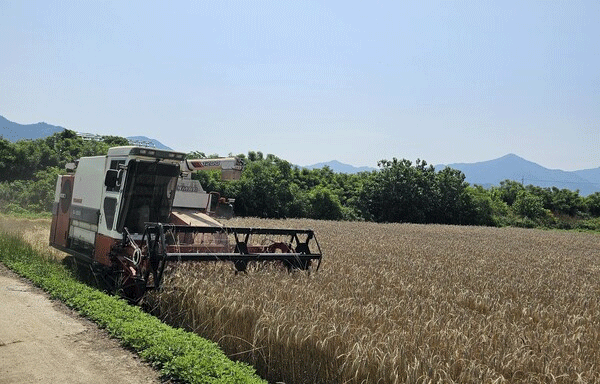
In a pioneering move, Yeongam County, Jeollanam-do, has harvested 700 kg of organic triticale seeds—a high-yield hybrid of wheat (Triticum) and rye (Secale). This marks South Korea’s first successful organic cultivation of the crop, signaling new opportunities for drought-resistant and sustainable cereal farming.

Why Triticale?

Triticale combines the best traits of wheat (high yield) and rye (hardiness), making it ideal for:

  • Marginal soils where traditional wheat struggles
  • Climate resilience due to drought and cold tolerance
  • Livestock feed & biofuel, offering farmers diversified income

Globally, triticale production has grown by 12% since 2020, with Poland, Germany, and Australia leading adoption.

From Research to Farms

The harvested seeds will serve dual purposes:

  1. Research: Sent to the National Institute of Agricultural Sciences to optimize cultivation techniques.
  2. Farm Distribution: Sold to local growers, helping expand South Korea’s organic and climate-smart crop options.

Field trials in similar climates (e.g., northern China) show triticale yields up to 15% higher than rye under low-fertility conditions.

Yeongam’s triticale breakthrough highlights the potential of hybrid crops in sustainable agriculture. By investing in resilient varieties like triticale, farmers can enhance food security while adapting to climate challenges.

Error

Tags: Agricultural InnovationCereal Cropsclimate-resilient cropsOrganic Farmingseed productionSouth Korea farmingsustainable agriculturetriticalewheat-rye hybridYeongam County

Tatiana Ivanova

Next Post
North Korea’s Wheat and Barley Harvest Begins: Can Increased Production Meet Food Demand?

North Korea’s Wheat and Barley Harvest Begins: Can Increased Production Meet Food Demand?

Newsletter

Bangladesh Secures 100,000 Tonnes of Vietnamese White Rice to Stabilize Domestic Market

Bangladesh Secures 100,000 Tonnes of Vietnamese White Rice to Stabilize Domestic Market

26 February 2025

Misuse of Pesticides: A Costly Mistake for Farmers and the Agriculture Industry

6 June 2025

Corn Leafhopper Alert: Protecting Late-Planted Corn from Devastating Stunt Disease

25 July 2025

India Eyes Record-Breaking Wheat Harvest in 2024-25: Will It Outpace All Expectations?

2 April 2025

Sichuan’s 30-Year Journey to Corn Yield Mastery: Insights from the Fengcheng Experience

8 September 2024

Canada’s Quiet Crop Champion: How Saskatchewan Lentils Conquered Global Markets

25 March 2025

Harnessing Meteorological Insights: Elevating Corn Seed Production in Gansu Province

17 October 2024

From Wheat to Wealth: How Deep Grain Processing is Revolutionizing Agriculture and Industry

30 July 2025

Russia’s Wheat Exports Reach Record Highs, Aiming for Continued Growth in Global Market Share

2 November 2024

Heat and Drought in Krasnodar Krai Threaten Corn Yields: Can Early-Maturing Hybrids Save the Harvest?

17 July 2025
  • About
  • Advertise
  • Careers
  • Contact
Call us: +51 93 999 5140

© 2020-2024 Field Crops news

Welcome Back!

Login to your account below

Forgotten Password?

Retrieve your password

Please enter your username or email address to reset your password.

Log In
No Result
View All Result
  • Home
  • News
  • Science
  • Sustainability
  • AgroTech & Innovation
  • Market News
  • Science
  • Research & Development
  • About
  • Contact

© 2020-2024 Field Crops news