• About
  • Advertise
  • Careers
  • Contact
Saturday, December 13, 2025
  • Login
No Result
View All Result
Field Crops news
  • Home
  • News
  • AgroTech & Innovation
  • Science
  • Sustainability
  • Market News
  • Research & Development
  • Home
  • News
  • AgroTech & Innovation
  • Science
  • Sustainability
  • Market News
  • Research & Development
No Result
View All Result
Field Crops news
No Result
View All Result
Home Climate

The Silent Crisis in Japan’s Rice Fields: Climate, Imports, and the Fight for Food Sovereignty”

by Tatiana Ivanova
16 June 2025
in Climate, Import, News
0
The Silent Crisis in Japan’s Rice Fields: Climate, Imports, and the Fight for Food Sovereignty”
0
SHARES
11
VIEWS
Share on FacebookShare on Twitter

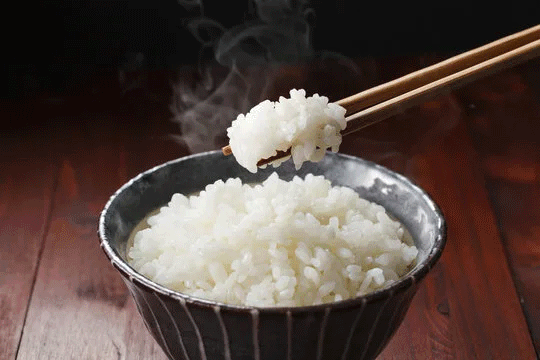
For centuries, rice has been the heart of Japan’s cuisine, economy, and identity. Yet today, the sector is under siege. Domestic production is shrinking due to climate extremes, while imports from the U.S., South Korea, and other countries flood the market. Japanese consumers, loyal to their sticky japonica varieties, remain skeptical of foreign rice—but rising costs are forcing a reckoning.

Climate Chaos and Shrinking Harvests

Record-breaking heatwaves and erratic rainfall have devastated yields. In 2023, Japan’s rice production dropped by 8% year-on-year, pushing reserves to a 30-year low (MAFF, 2024). By March 2024, the government released 300,000 tons from emergency stockpiles, yet prices still surged to ¥4,285 ($30) per 5 kg—double 2023 levels (The Guardian). Meanwhile, tourist demand (rebounding to pre-pandemic levels) strains supplies further.

The Import Dilemma

Historically, Japan protected its rice farmers with strict tariffs (up to 778% on imports) and price controls. But with consumer frustration mounting, policymakers face pressure to deregulate. The U.S. and Southeast Asia offer rice at half the cost, yet cultural resistance persists: surveys show 72% of Japanese consumers prefer domestic rice for taste and food safety (Nikkei, 2024).

A Fragile Future

The government’s subsidy-heavy approach is unsustainable. Farmland is shrinking (55,000 hectares lost since 2000), and the average farmer is now 67 years old (JA Group, 2024). Without innovation—like drought-resistant strains or vertical farming—Japan may soon rely on imports for 20% of its rice (up from 7% today), eroding food sovereignty.

Japan’s rice crisis reflects a global challenge: balancing tradition with economic realities. To survive, the sector must modernize while preserving quality. Otherwise, the nation risks losing more than a crop—it could forfeit a cornerstone of its culture.


Error
Tags: AgricultureAgronomyClimate ImpactEconomic PolicyFarmersfood securityImport DependencyJapan Rice CrisisSustainable Farming

Tatiana Ivanova

Next Post
Locust Swarms Threaten Volgograd Wheat Fields: Are We Prepared for the Next Agricultural Crisis?

Locust Swarms Threaten Volgograd Wheat Fields: Are We Prepared for the Next Agricultural Crisis?

Newsletter

WASDE Numbers Trigger a Three Percent Drop in US Wheat Prices

WASDE Numbers Trigger a Three Percent Drop in US Wheat Prices

15 July 2024

Advancing Sustainable Agriculture in Iowa: Insights from the Nutrient Reduction Survey

15 October 2024

New study on adult plant resistance to Bipolaris sorokiniana on barley in Canada

17 June 2024

Federal Government Allocates R$ 6.8 Billion to Boost Brazilian Coffee Sector

7 July 2024

Contaminated Barley Shipments Raise Alarm: Pesticide Risks in Animal Feed Demand Stricter Controls

25 June 2025

122.6 Tons of Barley and Rye Seeds Distributed in Jeonnam: Boosting Crop Yields with Certified Varieties

2 September 2024

Wet French Harvest Causes Quality Issues

7 August 2024

Nigeria’s Wheat Farmers Get a Boost: FG Launches Subsidized Input Program in Kano

25 December 2024

Drought and Pests Render Rostov Wheat Seeds Unfit for 2026 Planting Season

18 August 2025

Crackdown on False Grain Declarations: 62,000 Tons of Grain Under Scrutiny in Dagestan

11 September 2024
  • About
  • Advertise
  • Careers
  • Contact
Call us: +51 93 999 5140

© 2020-2024 Field Crops news

Welcome Back!

Login to your account below

Forgotten Password?

Retrieve your password

Please enter your username or email address to reset your password.

Log In
No Result
View All Result
  • Home
  • News
  • Science
  • Sustainability
  • AgroTech & Innovation
  • Market News
  • Science
  • Research & Development
  • About
  • Contact

© 2020-2024 Field Crops news