

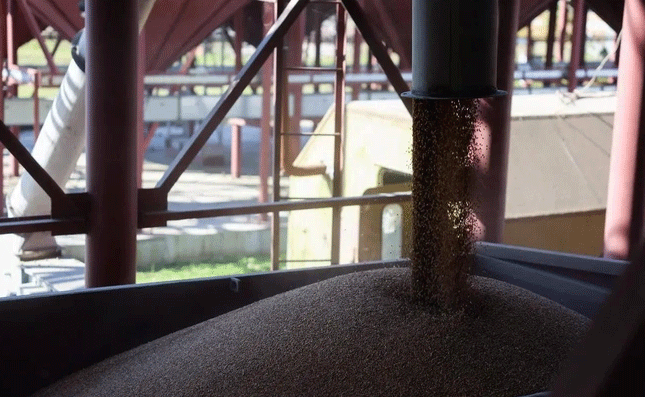
In the Omsk region of Siberia, a bountiful harvest has become a curse. Farmers are on track to harvest a record four million tonnes of grain, yet the celebration is absent. Instead, they face a catastrophic price collapse, with wheat selling for a mere 7,000-9,000 RUB per tonne, significantly below the estimated production cost of 10,000 RUB. The core of the problem is a profound market failure driven by geography and policy. Omsk produces three to four times more grain than it can consume locally, making exports its only viable outlet. However, the region is landlocked and situated thousands of kilometers from key export ports like those on the Black Sea. While port prices might be as high as 18,000 RUB per tonne, the prohibitive cost of rail transport—8,000-9,000 RUB—devours any potential profit. This situation is exacerbated by the closure of the Kazakh market, a traditional buyer, and chronic railcar shortages, leaving elevators overflowing and forcing farmers to store grain in temporary bags on the ground.
The crisis is further intensified by a shrinking domestic livestock sector, which has reduced demand for feed grains, and a lack of new export market diversification. Experts and farmers point to a critical policy failure: the federal government’s push for a 25% increase in grain production by 2030 is completely disconnected from investments in logistics and market access. While China presents a potential outlet, phytosanitary protocols for feed wheat have not been agreed upon, and logistical bottlenecks at border crossings like Dostyk persist. Furthermore, the lack of rail subsidies for grain, unlike for “socially significant” commodities like coal and cement, makes it economically unviable to move Siberian grain to either western ports or eastern borders. The result is a wave of farm closures, particularly among smaller operators, and a forced consolidation of land into larger holdings. In response, some surviving farms are desperately diversifying into durum wheat, oilseeds, and malting barley, but these niche markets have limited capacity to absorb the region’s massive grain surplus.
The crisis in Omsk is a stark warning of the dangers of prioritizing production volume over economic sustainability. It demonstrates that a successful agricultural sector cannot be built on yield figures alone; it requires a fully integrated strategy that includes efficient logistics, strategic market development, and responsive policy. Without urgent government intervention to subsidize transport, aggressively open new export markets, and incentivize deep domestic processing, the Siberian breadbasket risks a systemic collapse. The ironic and very real prospect, as voiced by local farmers, is that a region drowning in grain today could be forced to import it tomorrow if the economic foundation of its agriculture is not restored.
Error