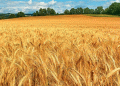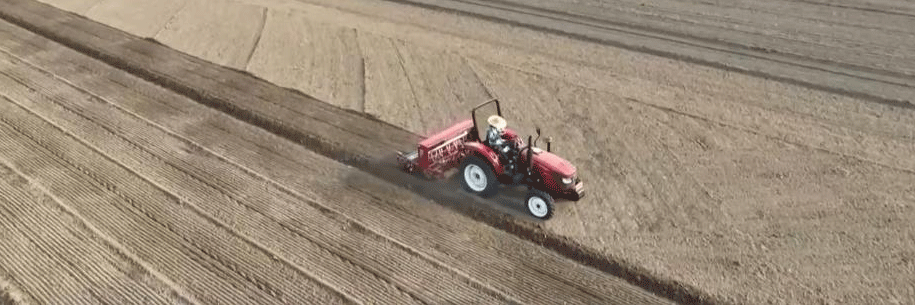
The recent cold snap has raised legitimate concerns among wheat growers about weak seedlings and winterkill in late-sown fields. According to experts like Li Shengdong, a scientist with the National Wheat Industry Technology System, the management strategy for the “pre-winter golden period” is not one-size-fits-all but requires careful classification based on seedling condition. For late-planted wheat, three immediate tasks are critical: checking and reseeding sparse areas, conserving soil moisture and preventing frost through timely shallow tillage (known as huachu), and applying herbicides during the pre-emergence period to suppress weed growth. These steps are vital for strengthening the plants before the deep winter sets in.
Differentiated Management: From Strong Seedlings to Weak Ones
The expert guidance emphasizes a tailored approach. For strong seedlings, conventional practices like soil pressing (zhenya) can enhance winter hardiness. However, for weak seedlings, farmers must be more cautious. Practices like pressing and chemical weeding should be applied judiciously, based on specific field conditions. A key recommendation for all fields is to perform mechanical shallow tillage in the early spring to raise soil temperature, which stimulates early and rapid growth and accelerates population development. This aligns with broader agricultural research; studies show that a 1°C increase in early spring soil temperature can advance wheat tillering by 3-5 days and potentially increase final yield by 5-7% by extending the critical growth period.
Long-Term Resilience: Building a “Sturdier” Wheat System
Beyond immediate seasonal management, experts advise a strategic shift towards defensive farming practices to build systemic resilience against increasingly common extreme weather events. Techniques like deep plowing and integrated water-fertilization (drip irrigation) are highlighted as crucial for creating a more robust crop that can better withstand climatic stresses. Data from the FAO indicates that water-efficient irrigation systems, when combined with precise fertilization, can not only reduce water usage by 30-50% but also improve nutrient uptake efficiency by 15-25%, leading to stronger root systems and more stress-tolerant plants. The old agricultural proverb, as cited by Scientist Li—”If the ground isn’t frozen by the Start of Winter, sow all the seeds you have”—underscores the importance of seeding during favorable weather windows, but it is the subsequent, science-based management that ultimately determines the success of that sowing.
Precision and Proactivity for Winter Wheat Success
The management of late-sown wheat is a test of precision agriculture and proactive planning. The immediate focus must be on leveraging the short pre-winter window to ensure plant survival through targeted interventions like reseeding, frost protection, and weed control. Following this, a differentiated management plan for the spring, particularly the use of mechanical tillage to warm the soil, is essential for regaining the growth momentum lost due to late planting.
For long-term sustainability and risk reduction, integrating defensive technologies such as deep plowing and water-fertilization integration is no longer optional but a necessity for “future-proofing” wheat production against climate volatility. By combining these precise in-season tactics with resilient system-level practices, farmers can transform the challenge of late sowing into an opportunity for a stable and satisfactory harvest.
Error