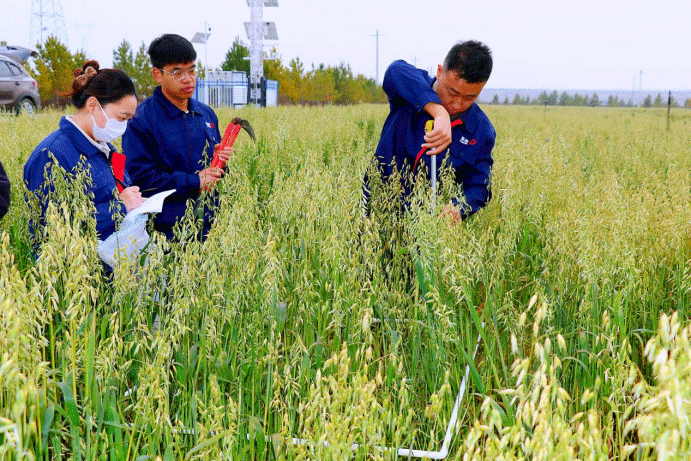
The quest for high-yielding, resilient forage oats has long led many producers to depend on imported varieties. However, a recent series of large-scale demonstration plantings across China’s major oat-producing regions signals a powerful shift. Led by Mengcao Ecology and Modern Grass Industry, these trials in Inner Mongolia, Gansu, and Hebei have unveiled a new generation of domestic oat varieties that are not just competing with—but substantially outperforming—their international counterparts.
The results are striking. Data collected from the demonstration bases show that key domestic varieties, including Mengyan 4, Mengnongda 7, and Mengnongda 8, achieved an approximate 30% improvement in critical agronomic traits such as plant height, flag leaf length, and flag leaf width compared to introduced foreign varieties. This morphological superiority translates directly into the bottom line: yield. The theoretical fresh weight yield of the new domestic oats reached 2,568 kg per mu, surpassing the foreign varieties by 334 kg per mu. This represents a yield increase of about 15%, a significant margin in the competitive forage market.
This development is a critical step toward greater agricultural self-sufficiency. Reliance on imported seed creates vulnerability to global supply chain disruptions and price volatility. The success of these domestic varieties aligns with a global trend of prioritizing locally adapted genetics. A 2024 report from the UN Food and Agriculture Organization (FAO) on forage crops emphasized that “locally-bred cultivars are often uniquely equipped with resilience to regional biotic and abiotic stresses, providing more stable production in the face of climate variability.” The new Chinese oats exemplify this, having been specifically selected for superior stress resistance and quality, allowing them to thrive in diverse and sometimes marginal environments.
Beyond raw performance, the strategic value lies in the expanded genetic portfolio. Mengcao Ecology now boasts a library of over 40 proprietary forage varieties. This diversity is a powerful tool for agronomists and farmers. The varieties are reported to have wide adaptability, covering provinces like Inner Mongolia, Shanxi, Hebei, Liaoning, and Gansu, including areas with high altitude and low precipitation. This effectively expands the viable acreage for high-quality oat production and provides tailored solutions for different microclimates and soil types, moving beyond a one-size-fits-all approach.
The demonstration of these new domestic oat varieties marks a pivotal moment for China’s forage industry. The consistent reports of a 30% gain in key traits and a solid 15% yield advantage demonstrate that domestic breeding programs have reached a level of sophistication that can directly benefit farmers. For agricultural professionals, this means access to more resilient, higher-yielding, and locally adapted seed options that can reduce input risks and enhance profitability. This homegrown breakthrough not only strengthens the competitiveness of domestic forage production but also bolsters the entire foundation of the livestock sector, paving the way for a more secure and sustainable agricultural future.
Error