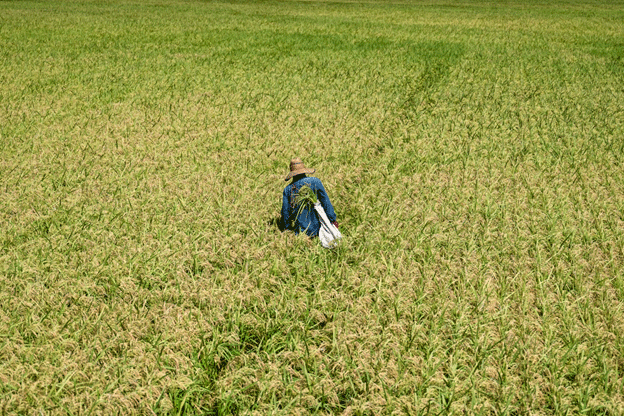
As Texas grapples with severe water shortages and escalating costs, rice farmers are facing unprecedented challenges that threaten their livelihoods and the state’s agricultural heritage. The Lower Colorado River Authority (LCRA) first cut off water allocations to rice farmers in 2012, and the situation has only worsened in recent years. With water once again unavailable in July 2023, nearly half of Texas’ rice acreage—over 71,000 acres—has been enrolled in the federal prevented planting program.
For many farmers like Berglund, who operates fields in Wharton and Matagorda counties, the inability to access water has led to “idle” land and financial strain. “Prevented planting” provisions in federal crop insurance provide some relief, covering up to 60% of lost income, but this falls short of the full financial impact. The significant costs of drilling wells—ranging from $300,000 to $700,000—are prohibitive for many, especially in areas like Matagorda County, where groundwater is too saline for rice cultivation.
Rising Costs and Climate Change Impact
Nationwide, drought has become a major driver of crop insurance payouts, skyrocketing from $1 billion in 2001 to $7.6 billion in 2021. This trend underscores the growing financial pressures on farmers. In addition to drought, climate change brings other risks such as increased storm intensity. Hurricane Beryl, which made landfall in Matagorda County as a Category 1 storm in July 2023, damaged crops and complicated harvests, marking an unprecedented event in the region’s history.
Farmers also rely on Price Loss Coverage, a USDA program designed to subsidize losses when market prices fall below the “effective reference price.” However, the current reference price of $14 per 100 pounds of rice is outdated compared to rising production costs, which have increased by 35% since the 2018 Farm Bill. Farmers like Lowell “LG” Raun, who recently advocated for updated policies in Washington, D.C., stress the need for a revised Farm Bill to ensure their survival.
Land Conversion and Economic Pressures
The decline in rice farming is also driven by land conversion. Urbanization and green energy projects, including wind, solar, and hydrogen farms, have increasingly encroached on traditional rice farming areas. For example, the historic Pierce Ranch in Wharton County has transitioned 2,800 acres to solar energy, driven by the more lucrative returns from renewable energy projects compared to traditional rice farming.
While some farmers, such as Paul Sliva, argue for preserving agricultural land to safeguard the domestic food supply, others find the economic incentives of solar and wind farms too compelling to ignore. Solar leases offer $1,000 per acre annually, providing a more stable income than fluctuating crop prices. This shift reflects a broader trend where renewable energy projects are prioritized over agriculture, exacerbating the challenges faced by traditional rice farmers.
The Promise of New Reservoirs
Amid these challenges, there is a glimmer of hope with the ongoing construction of the Arbuckle Reservoir near Lane City, Wharton County. This $456 million project, expected to add more than 80,000 acre-feet to the region’s water supply, aims to alleviate some of the water scarcity issues. However, John Hofmann of the LCRA warns that even with this new reservoir, the future remains uncertain. As population growth in Central Texas continues to outpace water supply, the availability of interruptible water for rice farmers is likely to diminish.
Navigating a Difficult Future
Texas rice farmers are at a crossroads, grappling with severe water shortages, high production costs, and land conversion pressures. While new water infrastructure offers some hope, the long-term viability of rice farming in Texas depends on adapting to a rapidly changing environment and finding a sustainable balance between agricultural and urban needs.
Error