• About
  • Advertise
  • Careers
  • Contact
Friday, December 5, 2025
  • Login
No Result
View All Result
Field Crops news
  • Home
  • News
  • AgroTech & Innovation
  • Science
  • Sustainability
  • Market News
  • Research & Development
  • Home
  • News
  • AgroTech & Innovation
  • Science
  • Sustainability
  • Market News
  • Research & Development
No Result
View All Result
Field Crops news
No Result
View All Result
Home Diseases

Tar Spot in Corn: Emerging Threat, Proven Strategies, and How to Protect Your Yield

by Tatiana Ivanova
23 May 2025
in Diseases, News
0
Tar Spot in Corn: Emerging Threat, Proven Strategies, and How to Protect Your Yield
0
SHARES
9
VIEWS
Share on FacebookShare on Twitter

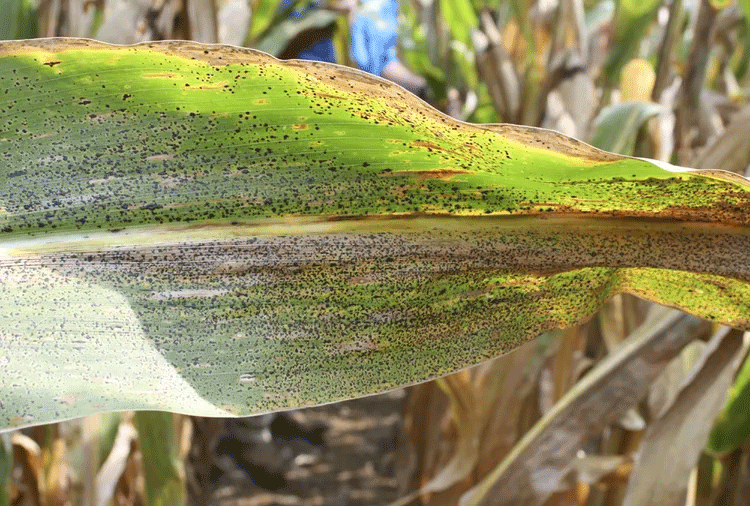
Tar spot (Phyllachora maydis) has become one of the most concerning diseases for corn growers in the U.S. Since its first detection in 2015, it has spread rapidly across the Midwest, causing significant economic damage. According to the Crop Protection Network (CPN), yield losses can reach 50 bushels per acre under severe infections, with the worst cases reported in Illinois, Indiana, and Wisconsin.

Symptoms and Spread

The disease is easily identified by its black, raised stromata embedded in leaves, which cannot be rubbed off. In advanced stages, lesions may appear on husks and tassels, further reducing photosynthesis and grain fill. Unlike other foliar diseases, tar spot thrives in cool (60-70°F), humid conditions, with infection requiring at least seven hours of leaf wetness.

Recent studies from Purdue University (2023) confirm that the fungus survives on crop residue, making continuous corn rotations particularly vulnerable. Additionally, irrigated fields face higher risk due to prolonged moisture.

Management Strategies

  1. Fungicide Applications – Research shows that two well-timed fungicide sprays (VT-R2) with multiple modes of action (e.g., QoI + DMI + SDHI) provide the best control. Products like Miravis Neo® and Veltyma® have shown strong residual activity.
  2. Hybrid Selection – Companies like Syngenta and Pioneer are developing tar spot-tolerant hybrids, which can reduce losses by 20-30% in high-pressure areas.
  3. Residue Management & Crop Rotation – Reducing infected residue through tillage or rotation with soybeans can lower spore loads.
  4. Scouting & Early Detection – Fields should be monitored from V8 through R4, as tar spot can explode within days under favorable conditions.

Tar spot is no longer an emerging threat—it’s here, and it’s costing growers millions. However, with proactive scouting, smart hybrid choices, and strategic fungicide use, farmers can mitigate losses. As research continues, staying updated on the latest recommendations from university extensions and agronomists will be key to long-term management.


Error
Tags: AgronomyCorn Diseasecorn farmingcrop protectionfarm managementFungicide ManagementPlant PathologyPrecision AgTar Spotyield loss

Tatiana Ivanova

Next Post
Gray Leaf Spot in Corn: How to Protect Your Crop from 50% Yield Loss

Gray Leaf Spot in Corn: How to Protect Your Crop from 50% Yield Loss

Newsletter

A Visit to Peru: Meeting the Remarkable Specialist Mg.Sc. Hugo Elías, HUANUQUEÑO COCA

A Visit to Peru: Meeting the Remarkable Specialist Mg.Sc. Hugo Elías, HUANUQUEÑO COCA

20 June 2024

The Birth of a New Giant? Exploring the Latest Advances in Harvester Technology

5 July 2024

Easing Rice Shortages: Japan’s Agriculture Ministry Reassures Consumers with Rice Harvest Updates

16 September 2024

World Rice Day: Exploring Varieties, Cultivation in Kuban, and Research at the Grain Quality Assessment Center

5 October 2024

The ABCD of Global Grain Trade: How Four Giants Shape the Market and What It Means for Farmers and Consumers

19 December 2024

Beyond the Bin: How Kurgan Oblast is Engineering an Agricultural Renaissance

7 November 2025

Syria Launches Tender for 100,000 Tons of Milling Wheat—But Will Russian Grain Be Left Out?

6 April 2025

Breeding for Resilience: How EkoNiva’s Wheat Program is Securing Russia’s Breadbasket

3 November 2025

Grain Safety at Risk: Why Over 1,000 Grain Declarations Were Revoked in Stavropol

8 December 2024

Favorable Forecast: Rising Temperatures to Boost Corn Maturity and Sugar Beet Quality

29 August 2025
  • About
  • Advertise
  • Careers
  • Contact
Call us: +51 93 999 5140

© 2020-2024 Field Crops news

Welcome Back!

Login to your account below

Forgotten Password?

Retrieve your password

Please enter your username or email address to reset your password.

Log In
No Result
View All Result
  • Home
  • News
  • Science
  • Sustainability
  • AgroTech & Innovation
  • Market News
  • Science
  • Research & Development
  • About
  • Contact

© 2020-2024 Field Crops news