Inner Mongolia’s arid and semi-arid regions have long faced agricultural challenges due to climate variability and limited water resources. However, recent innovations in crop management, value-added processing, and smart farming are driving remarkable growth in both yields and farmer incomes. Three key sectors—drought-resistant wheat, chili peppers, and high-tech mushroom cultivation—demonstrate how sustainable practices and industrialization are reshaping local agriculture.
1. Drought-Resistant Red Wheat: A Heritage Crop with High Market Value
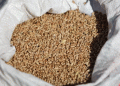
In Shihaihe Town, Urad Middle Banner, farmers like Liu Yongping are cultivating “Baisuihong” red wheat, a heritage variety introduced in the late Qing Dynasty. This wheat thrives in dryland conditions, requiring no chemical fertilizers or pesticides, and benefits from over 1,800 annual sunlight hours, resulting in 14% protein content and 31% wet gluten—exceptional quality for baking and noodles8.
Key developments in this sector include:
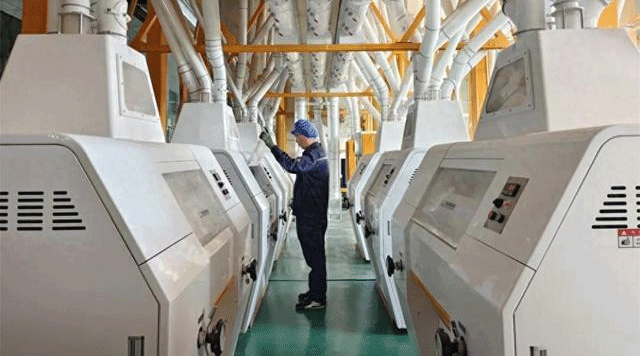
- Value-Added Processing: Local enterprises like Gaotaerliang and Taokuan process wheat into flour, steamed buns, and noodles, increasing profitability.
- E-Commerce Expansion: A “e-commerce + agricultural promoters” model has boosted sales, with organic wheat products achieving a 200% price premium in 2024.
- Economic Impact: 150 farming households saw an average income increase of ¥12,000 per year8.
2. Chili Peppers: From Field to High-Value Products
In Deling Mountain Town, chili farming has evolved into a high-tech, high-value industry. Grower Yang Jianmin manages 2,150 acres using factory seedling cultivation and mechanized transplanting, improving survival rates from 85% to 98%8.
Key advancements:
- Precision Agriculture: The town’s 65,400 acres of farmland (35,000 acres high-standard) produce crisp, flavorful peppers due to fertile soil and clean water.
- Deep Processing: Companies like Manchang Agricultural Technology use supercritical CO₂ extraction to produce high-purity capsaicin for pharmaceuticals and cosmetics.
- Industrial Clusters: The town is developing a “One Park, One City, Two Bases, N Processing Plants” model to strengthen the supply chain8.
3. Smart Mushroom Farming: High-Yield, High-Profit Cultivation
The Hailiutu Town Chunjin Agricultural Industrial Park showcases automated mushroom farming, with 78 intelligent greenhouses controlling temperature and humidity for optimal Stropharia rugosoannulata (wine cap mushroom) growth.
Key highlights:
- High Productivity: Each greenhouse yields 7,500 lbs per cycle, with 2-3 cycles annually, generating ¥200,000 ($28,000) per greenhouse per year.
- Market Reach: Products are sold in Shanghai and Hangzhou, premium urban markets78.
- Economic Boost: The ¥62.6 million ($8.6 million) project supports local employment and agri-tech adoption7.
The Future of Sustainable Farming in Arid Regions
Inner Mongolia’s agricultural transformation demonstrates how drought-resistant crops, value-added processing, and smart farming can enhance food security and rural prosperity. By integrating traditional knowledge with modern agribusiness, farmers are achieving higher yields, better incomes, and climate resilience.
Error