
• About
  • Advertise
  • Careers
  • Contact
Friday, December 5, 2025
  • Login
No Result
View All Result
Field Crops news
  • Home
  • News
  • AgroTech & Innovation
  • Science
  • Sustainability
  • Market News
  • Research & Development
  • Home
  • News
  • AgroTech & Innovation
  • Science
  • Sustainability
  • Market News
  • Research & Development
No Result
View All Result
Field Crops news
No Result
View All Result
Home Company

Struggling with Falling Rice Prices: North Gyeongsang Farmers Face Tough Harvest

by Tatiana Ivanova
17 September 2024
in Company, News, Prise
0
Struggling with Falling Rice Prices: North Gyeongsang Farmers Face Tough Harvest
0
SHARES
5
VIEWS
Share on FacebookShare on Twitter

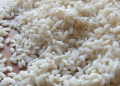
As North Gyeongsang approaches the rice harvest season, the region’s once-promising fields are now marred by the troubling impact of sharply declining rice prices. Farmers are facing an unprecedented dilemma as they are forced to uproot their crops, turning what should have been a bountiful harvest into a scene of barren fields.

Price Plummet and Economic Strain

Rice prices have fallen significantly over the past year. In October 2023, the price of 80 kilograms of rice was around 210,000 won, but it has since dropped to approximately 170,000 won, with some areas in North Gyeongsang seeing prices as low as 150,000 won. This drastic decline has placed immense financial strain on farmers, who are struggling to cover production costs.

Shin Jeong-hyun, a local rice farmer, expressed the severity of the situation: “Rice is like our salary, and now the production costs aren’t even being covered. It’s incredibly discouraging for us farmers.” The economic pressure is further compounded by the fact that rice stocks held by local cooperatives in North Gyeongsang have surged to 40,000 tons, double the amount from the previous year.

Government Response and Measures

In response to the crisis, North Gyeongsang Province has announced plans to reduce rice cultivation areas and promote alternative crops through a variety of support programs. A significant aspect of this strategy includes encouraging the cultivation of other crops and boosting rice consumption through national campaigns. Ahn Young-mi, the head of the province’s rice management team, stated: “We will reduce the area dedicated to rice cultivation through support for alternative crops and enhance rice consumption initiatives to stabilize prices.”

The South Korean government has also pledged to purchase 450,000 tons of new rice as part of its price stabilization measures. However, farmers remain cautious, watching closely to see if these interventions will have the desired effect on stabilizing the market.

The current rice price crisis in North Gyeongsang underscores the broader challenges facing the agricultural sector amidst fluctuating market conditions and rising stock levels. While government initiatives and provincial measures aim to address these issues, the effectiveness of such strategies will be critical in determining the future stability of rice prices and the well-being of farmers.

Error

Tags: Agricultural EconomicsCrop SupportFarmers CrisisGovernment InterventionMarket StabilizationNorth GyeongsangRice ConsumptionRice HarvestRice pricesSouth Korea

Tatiana Ivanova

Next Post
Pioneering Flour Rice: Cheongju’s Push to Replace Imported Wheat

Pioneering Flour Rice: Cheongju's Push to Replace Imported Wheat

Newsletter

Ergot of cereals

Ergot of cereals

17 July 2024

New York Newest Vegan Spot: No Shade From Us, Shady Shack Is On Point

16 April 2024

Weather Patterns Impact Australian Agricultural Regions

7 August 2024

Cracking the Genetic Code of Wheat Disease Resistance: Inside China’s 5-Year Breakthrough

12 April 2025

Chinese Researchers Harness Gene Editing to Combat Wheat ‘Cancer

2 July 2024

Rye Planting in High-Altitude Fields of Jeongseon: A Natural Solution to Prevent Soil Erosion and Nutrient Loss

3 September 2024

Mandatory Integration of Seed Information into Russia’s ‘Grain’ System: Implications for Agricultural Stakeholders​

6 March 2025

USDA Forecasts 47% to 61% Increase in Food Production Needed by 2050

2 July 2024

Wheat Prices Rise as Imports Drop: Key Market Trends and Insights for Farmers

10 November 2024

Myanmar’s Pulse Export Success Amid Price Fluctuations: Black Gram and Mung Bean Prices Decline

3 December 2024
  • About
  • Advertise
  • Careers
  • Contact
Call us: +51 93 999 5140

© 2020-2024 Field Crops news

Welcome Back!

Login to your account below

Forgotten Password?

Retrieve your password

Please enter your username or email address to reset your password.

Log In
No Result
View All Result
  • Home
  • News
  • Science
  • Sustainability
  • AgroTech & Innovation
  • Market News
  • Science
  • Research & Development
  • About
  • Contact

© 2020-2024 Field Crops news