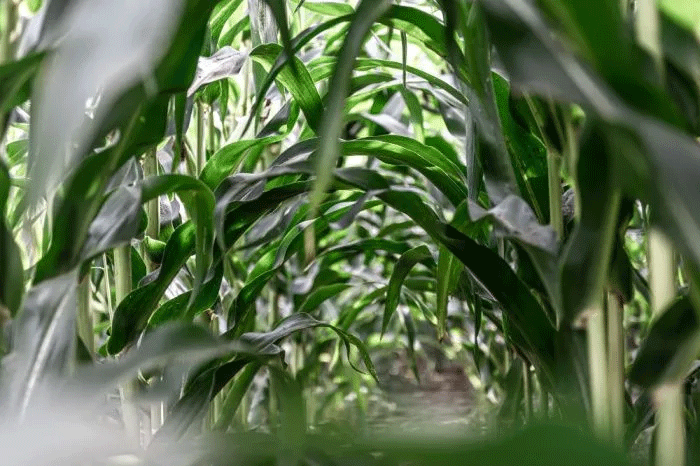
The Republic of Kabardino-Balkaria has embarked on an ambitious agricultural mission: to supply 25% of Russia’s corn seed requirements within the next five years. This bold initiative represents a strategic push toward greater seed sovereignty and reduced import dependence in Russia’s agricultural sector, with production targets increasing from 15,000 to 18,000 tons by 2030.
Current Russian Seed Market Dynamics
Russia’s corn seed market presents substantial opportunities for domestic producers:
- Annual demand: Approximately 80,000 tons of corn seeds
- Current production: Primarily concentrated in southern and central regions
- Major producers: Kuban Corn Sorting Complex in Krasnodar Krai leads production
- Import dependence: Significant portion still imported despite recent growth in domestic production
The Kabardino-Balkaria initiative addresses a critical national priority. According to the Russian Ministry of Agriculture, reducing seed imports has become a strategic objective, with the government implementing support programs to increase domestic seed production by 30-40% over the next decade.
Production Expansion and Technical Capacity
Kabardino-Balkaria’s planned expansion from 15,000 to 18,000 tons represents a 20% production increase. This growth requires:
- Infrastructure investment: Modern processing and storage facilities
- Technical expertise: Advanced breeding and seed treatment capabilities
- Quality control: Implementation of international seed certification standards
- Research collaboration: Partnerships with agricultural research institutions
The republic’s current domestic requirement of 3,500 tons means approximately 77% of production (11,500 tons) is already available for export to other Russian regions, demonstrating established production capabilities.
Global Context for Seed Production
Kabardino-Balkaria’s initiative aligns with global trends in seed production and food security:
- Seed sovereignty: Countries worldwide are increasing domestic seed production capacity
- Technology transfer: Adoption of advanced breeding techniques and seed treatments
- Climate adaptation: Developing varieties suited to specific regional conditions
- Quality standards: Implementing international certification protocols
The Food and Agriculture Organization reports that countries achieving 60-70% domestic seed production typically experience 15-20% higher agricultural productivity due to better adaptation to local conditions.
Economic Impact and Market Opportunities
The expansion offers significant economic benefits:
- Job creation: Seed production typically generates 3-5 jobs per 100 tons of capacity
- Value addition: Processed seeds command 200-300% higher prices than commodity corn
- Technology spillover: Advanced seed production techniques benefit other agricultural sectors
- Export potential: Potential to supply neighboring countries and global markets
Research from the International Seed Federation indicates that each $1 invested in seed production infrastructure generates $3-4 in agricultural value addition downstream.
Technical Requirements and Innovation Needs
Achieving these targets requires substantial technical advancement:
- Breeding programs: Developing varieties adapted to specific Russian growing conditions
- Seed processing: Modern cleaning, treatment, and packaging facilities
- Quality assurance: Implementation of rigorous testing and certification protocols
- Storage infrastructure: Climate-controlled facilities maintaining seed viability
Challenges and Considerations
Several challenges must be addressed for successful implementation:
- Climate variability: Ensuring reliable production across varying growing seasons
- Disease management: Maintaining phytosanitary standards and seed health
- Market competition: Competing with established domestic and international suppliers
- Technical expertise: Developing and retaining skilled personnel in seed production
Strategic Importance for Russian Agriculture
This initiative supports broader Russian agricultural objectives:
- Food security: Reducing dependence on imported agricultural inputs
- Technological development: Building domestic expertise in advanced seed production
- Regional development: Creating agricultural hubs outside traditional production areas
- Export growth: Potential for Russian seed exports to global markets
Kabardino-Balkaria’s ambitious plan to supply 25% of Russia’s corn seed需求 represents a significant step toward agricultural self-sufficiency and demonstrates the growing strategic importance of seed production in national food security policies. The planned expansion from 15,000 to 18,000 tons by 2030, while ambitious, is achievable with proper investment in infrastructure, technology, and human capital.
This initiative offers valuable lessons for agricultural regions worldwide: the importance of developing domestic seed production capabilities, the economic benefits of moving up the agricultural value chain, and the strategic value of seed sovereignty in an increasingly uncertain global environment.
The success of Kabardino-Balkaria’s seed production expansion will depend on continued government support, technological innovation, and market development. However, the republic’s existing production capabilities and strategic positioning suggest strong potential for achieving these ambitious targets.
For farmers, agricultural engineers, and policymakers, this case study highlights the critical importance of seed systems in agricultural development and food security. As climate change and geopolitical uncertainties continue to affect global food systems, such investments in domestic seed production capacity will become increasingly valuable for ensuring agricultural resilience and productivity.
Error