• About
  • Advertise
  • Careers
  • Contact
Friday, December 5, 2025
  • Login
No Result
View All Result
Field Crops news
  • Home
  • News
  • AgroTech & Innovation
  • Science
  • Sustainability
  • Market News
  • Research & Development
  • Home
  • News
  • AgroTech & Innovation
  • Science
  • Sustainability
  • Market News
  • Research & Development
No Result
View All Result
Field Crops news
No Result
View All Result
Home AgroTech & Innovation

Secrets of Barley’s Evolution in a 95-Year-Old Experiment

by Tatiana Ivanova
29 July 2024
in AgroTech & Innovation, News, Science
0
Secrets of Barley’s Evolution in a 95-Year-Old Experiment
0
SHARES
5
VIEWS
Share on FacebookShare on Twitter

Long-Term Experiment Unveils Barley’s Adaptive Evolution

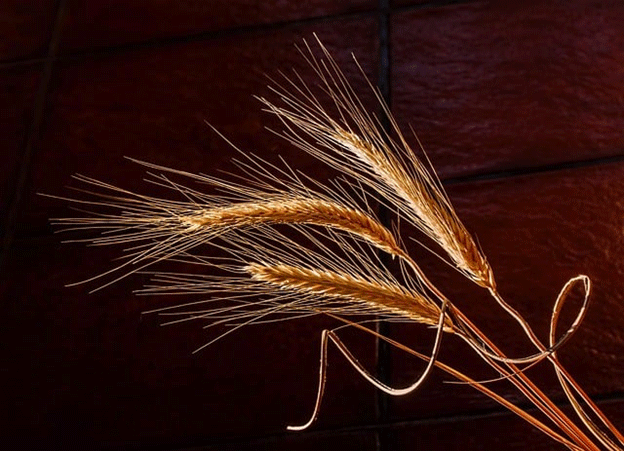
Researchers at the University of California-Riverside have uncovered how barley, a major agricultural crop, has adapted to changing environments and selective pressures over nearly a century. This research, detailed in a study published by the American Association for the Advancement of Science, emphasizes the importance of long-term studies in understanding adaptive evolution.

Barley, domesticated over 10,000 years ago, quickly became a staple for humans and livestock across Europe, Asia, and Northern Africa. This rapid expansion subjected barley to strong selective pressures, including artificial selection for desired traits and natural selection for diverse environments.

The Barley Composite Cross II Experiment

The Barley Composite Cross II (CCII) experiment, one of the world’s oldest evolutionary studies, began in 1929 in Davis, California. This multigenerational common garden experiment aimed to adapt a genetically diverse population of 28 barley varieties to local environmental conditions. Despite starting with thousands of genotypes, natural selection drastically reduced this diversity over time, leading to the dominance of a single clonal lineage by the 50th generation.

Researchers, led by Jacob Landis, found that the successful lineage was primarily composed of alleles from Mediterranean-like environments, similar to that of Davis. This indicated that local climate played a significant role in the adaptive process, particularly affecting genes related to reproductive timing.

Findings and Implications

The study revealed that local adaptation dominated barley’s evolution in the experiment. Although there were early, rapid gains in yield, the evolutionary breeding approach did not keep pace with the yield gains from pedigree-based breeding methods. This raises questions about why the most competitive genotypes produced during local adaptation are not necessarily the highest yielding.

“We found considerable evidence that local adaptation dominates evolution in this experiment,” Landis wrote. “However, understanding why the most competitive genotypes produced during local adaptation are not necessarily the highest yielding will be of great interest in the future.”

The CCII experiment provides invaluable insights into barley’s adaptive evolution under long-term environmental pressures. This research underscores the significance of maintaining long-term experiments to observe evolutionary dynamics directly and improve future agricultural practices.


Error
Tags: Adaptive EvolutionAgricultural ResearchBarley AdaptationBarley EvolutionClimate ImpactCrop Sciencegenetic diversityLong Term StudiesSelective BreedingUniversity Of California Riverside

Tatiana Ivanova

Next Post
Cereal Ingredients Market Poised for Significant Growth Through 2031

Cereal Ingredients Market Poised for Significant Growth Through 2031

Newsletter

The Quality of Annual and Perennial Grasses in the Krasnoyarsk Krai Confirmed

The Quality of Annual and Perennial Grasses in the Krasnoyarsk Krai Confirmed

2 September 2024

Chicago Wheat Prices Rise Amid U.S. and French Crop Concerns

26 July 2024

Government Initiatives to Mitigate Wheat Price Hike: An Insight into India’s Market Strategy

19 July 2024

New $55.9 Million Initiative Aims to Boost Water and Nutrient Efficiency in WA Grain Production

12 August 2024

Wheat Crisis in Russia’s Breadbasket: Don Region Reports Worst Yields in a Decade

18 August 2025

Minister Fávaro Delivers Agricultural Machinery in Rio Grande do Sul

7 July 2024

Harvesting Potential: How Sung Sim Dang Is Cultivating a Unique Daejeon Bread Brand Through Local Wheat Production

4 November 2024

The Resurgence of Kodo Millet: A Quick and Profitable Crop for Modern Farmers

31 July 2024

Beyond the Usual Suspects: How Tatarstan is Winning in the High-Stakes Chinese Grain Market

18 November 2025

Stavropol Farmers Harvest 3.3 Million Tons of Wheat by Early July

5 July 2024
  • About
  • Advertise
  • Careers
  • Contact
Call us: +51 93 999 5140

© 2020-2024 Field Crops news

Welcome Back!

Login to your account below

Forgotten Password?

Retrieve your password

Please enter your username or email address to reset your password.

Log In
No Result
View All Result
  • Home
  • News
  • Science
  • Sustainability
  • AgroTech & Innovation
  • Market News
  • Science
  • Research & Development
  • About
  • Contact

© 2020-2024 Field Crops news