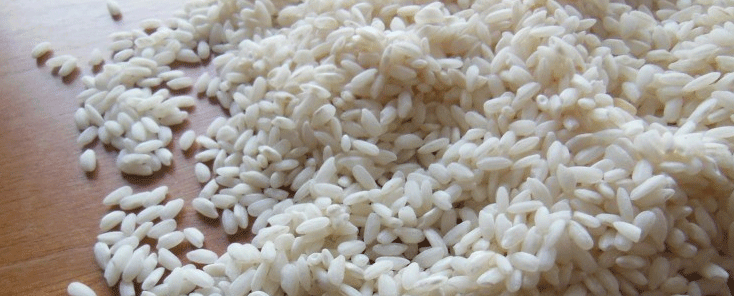
Russia is preparing to reopen its rice exports, focusing on value-added products like milled rice while keeping raw rice exports restricted. According to Deputy Prime Minister Dmitry Patrushev, this decision aligns with Russia’s goal of exporting processed goods rather than raw materials. Despite a record harvest of 1.2 million tons in 2023, domestic processing capacity (1.5 million tons) remains underutilized, reinforcing the need for export controls on raw rice.
Quota System to Regulate Exports
The Ministry of Agriculture plans to introduce a transparent quota mechanism by 2026, as announced by Sergei Smirnov, head of the department’s market regulation division. The proposed formula allocates 60% of the surplus above 1.1 million tons—the estimated domestic demand—for export. This approach aims to stabilize the market while allowing gradual trade expansion.
Current Export Restrictions and Industry Concerns
Since the export ban was imposed, Russia’s rice shipments dropped from 100,000–120,000 tons annually to just 40,000 tons, according to Valery Ladatko, an analyst at the National Rice Union (NRU). While the ban was initially justified after the 2022 Fedorovsky Dam collapse (which reduced harvests), recent record yields have made the restrictions economically counterproductive. Experts argue that prolonged export limits hurt profitability and demand, especially as domestic consumption (750,000–800,000 tons/year) is far below production potential.
Future Goals and Challenges
Russia aims to produce 2 million tons of rice by 2030, which could create an annual surplus of 350,000 tons of milled rice—far exceeding domestic needs. Without export opportunities, this surplus could depress prices and discourage farmers. The government is considering tariff-rate quotas (50,000 tons at 0% duty, with 50% for excess volumes) to manage trade flows while supporting processors.
Russia’s rice industry stands at a crossroads: expanding exports could boost farm incomes and processing efficiency, but policymakers must balance this with food security concerns. A well-designed quota system, paired with investments in value-added production, may offer a sustainable path forward.
Error