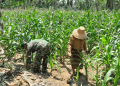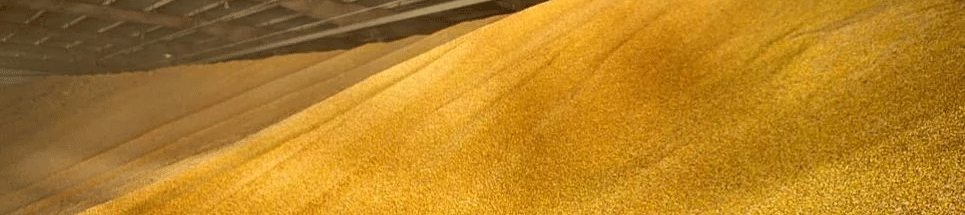
The 2025 Russian harvest is progressing at a formidable pace, with grain production already exceeding 105 million metric tons (MMT), according to a statement from Deputy Prime Minister Dmitry Patrushev. This strong performance, marked by yields “significantly exceeding” last year’s figures, solidifies the official forecast for a total grain harvest of 135 MMT. The milestone of 100 MMT was surpassed last week, indicating a rapid and efficient harvest campaign across all of Russia’s grain-producing regions.
This robust harvest is not limited to grains. Official reports indicate that the collection of other key agricultural commodities—sunflower, sugar beet, vegetables, and potatoes—within the organized sector is expected to be no lower than the strong volumes achieved in 2024. Concurrently, the crucial sowing campaign for the 2026 winter grain crop is already well underway. Farmers have sown winter cereals on 4 million hectares, with work having started in nearly half of Russia’s regions. The total planned area for winter crops remains stable at approximately 20 million hectares, consistent with the previous year’s sowing footprint.
To underpin this agricultural output, the Russian government has deployed substantial financial resources. A total of over 105 billion rubles (approx. $1.3 billion USD) has been directed to support farmers in 2025. In a notable move to improve liquidity for seasonal operations, the government has for the first time allocated an additional 18 billion rubles specifically to subsidize preferential short-term loans for seasonal field operations.
Deputy Prime Minister Patrushev outlined clear priorities for the coming weeks:
- Minimizing Harvest Losses: Ensuring the safe storage of the harvested crop through strict control of drying and storage capacity readiness, including elevators and granaries.
- Securing the Winter Sowing: Guaranteeing the timely completion of winter sowing, monitoring the phytosanitary condition of emerging seedlings, and ensuring farmers have uninterrupted access to key resources: machinery, high-quality seeds, and mineral fertilizers.
- Ensuring Resource Availability: The Ministry of Agriculture, in conjunction with the Ministry of Energy, has been tasked with monitoring fuel availability across regions.
- Efficient Subsidy Distribution: Regional authorities have been instructed to maintain constant oversight to ensure all state support funds are delivered to agricultural producers without delay.
Looking ahead to export potential, the Union of Grain Exporters and Producers forecasts the 2025/26 wheat harvest at 85-90 MMT. This would be a slight increase over the 2024/25 expected output of 82.6 MMT but remains below the record levels of 104.2 MMT achieved in 2022/23.
Russia’s 2025 agricultural season is demonstrating remarkable strength, driven by high yields and robust government financial backing. The strategic focus has now shifted from bulk harvesting to the dual challenge of preserving the quality of the current record-breaking harvest and successfully establishing the foundation for next year’s crop with the winter sowing campaign. The comprehensive support package, particularly the novel subsidies for short-term loans, highlights a proactive approach to mitigating operational risks for farmers. This positions Russia to maintain its role as a dominant and reliable force in the global grain market for the foreseeable future.
Error