
• About
  • Advertise
  • Careers
  • Contact
Friday, December 5, 2025
  • Login
No Result
View All Result
Field Crops news
  • Home
  • News
  • AgroTech & Innovation
  • Science
  • Sustainability
  • Market News
  • Research & Development
  • Home
  • News
  • AgroTech & Innovation
  • Science
  • Sustainability
  • Market News
  • Research & Development
No Result
View All Result
Field Crops news
No Result
View All Result
Home Market News

Russia’s Grain Intervention Sales Hit Another Record Low: What Does This Mean for Farmers and the Market?

by Tatiana Ivanova
21 May 2025
in Market News, News, Сrop protection
0
Russia’s Grain Intervention Sales Hit Another Record Low: What Does This Mean for Farmers and the Market?
0
SHARES
4
VIEWS
Share on FacebookShare on Twitter

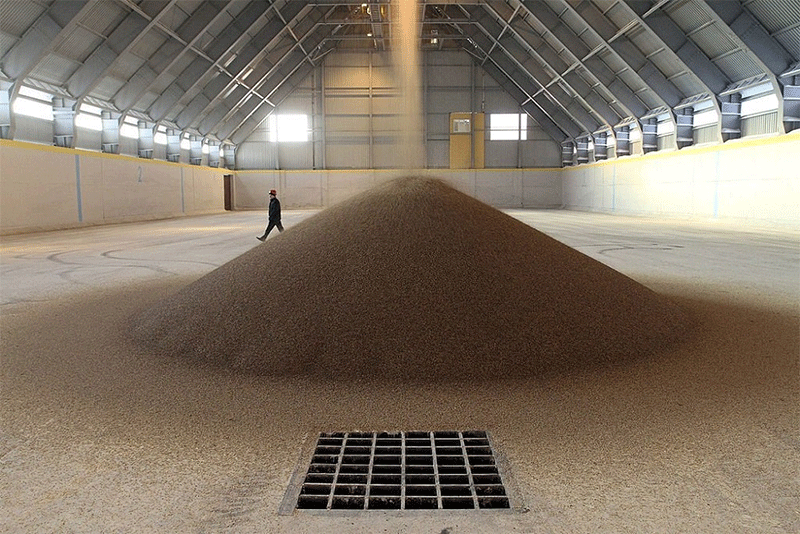
On Tuesday, May 20, grain sales from Russia’s state intervention fund fell sharply to a new record low of only 540 tons, according to data from the National Commodity Exchange (NTB). This marks a significant drop from the 4,050 tons sold just a day earlier and continues a concerning trend of declining state grain auctions.

Key Details from the Latest Auction:

  • Only one lot was sold: soft wheat (3rd class, “triple”) from the 2021 harvest—a rare occurrence in recent trading.
  • The wheat originated from Volgograd Oblast, selling for 8.53 million rubles at an average price of 15,840 rubles per ton.
  • Just one contract was signed for the entire lot.

This follows the previous record low set on May 14, when only 945 tons of the same class and harvest year were sold under similar conditions.

Broader Market Trends

Russia’s grain intervention mechanism, designed to stabilize domestic prices, has seen fluctuating demand since its relaunch in August 2023. After a pause in late December, sales resumed in January 2024, but volumes remain weak.

Total sales so far:

  • 192,780 tons of grain sold
  • 2.85 billion rubles in revenue

Why Are Sales Declining?

Several factors may explain the slump:

  1. Strong Export Demand: Russian wheat remains competitive globally, reducing domestic reliance on state reserves.
  2. Price Discrepancies: Intervention prices may no longer align with market expectations.
  3. Quality Concerns: Buyers may prefer fresher harvests over older stock (e.g., 2021 wheat).

What Does This Mean for Farmers and Agribusiness?

  • Farmers may face reduced price support if state interventions lose effectiveness.
  • Traders and processors could see greater price volatility if government stocks play a smaller role.
  • Global markets may feel pressure if Russia prioritizes exports over domestic sales.

The continued decline in Russia’s grain intervention sales highlights shifting market priorities—away from state-backed mechanisms and toward global trade dynamics. Farmers and agribusinesses should monitor these trends closely, as they may influence pricing strategies, storage decisions, and export opportunities in the coming months.


Error
Tags: AgribusinessAgricultural EconomicsAgricultureCommodity TradingCrop SalesFarmersGrain Marketmarket trendsRussia Grainwheat prices

Tatiana Ivanova

Next Post
Cracking Down on Grain Quality: Omsk Region’s Stricter Controls and What It Means for Agriculture

Cracking Down on Grain Quality: Omsk Region’s Stricter Controls and What It Means for Agriculture

Newsletter

The Short-Stature Revolution: How Compact Corn is Reshaping the Future of Row Crops

The Short-Stature Revolution: How Compact Corn is Reshaping the Future of Row Crops

23 October 2025

Cuba Opens Doors for Foreign Investment: Vietnamese Company to Grow Rice in Pinar del Río

15 January 2025

Saratov Region Launches Grain Transportation Complex Along the Volga: A Boost to Regional Agriculture and Export

25 October 2024

In-Field Analytics: How Mobile Labs are Shaping Harvest Strategy in Russia’s Kursk Region

15 November 2025

Maximizing the Value of Wheat Straw: How Zhanglang County’s Innovative Practices Are Boosting Beef Production and Sustainability

19 July 2024

Pioneering Tropical Wheat: Unhan and Unand Join Forces for Food Security Innovation

5 August 2024

The Disappearing Class: Why Oryol Region’s Premium Wheat Harvest is Shrinking

17 October 2025

Impressive Wheat Harvest in Krasnodar Reaches Nearly 45,000 Tons

6 July 2024

Unlocking Agricultural Potential: Soil Health Assessment as a Cornerstone for Productivity

13 June 2024

Pioneering Wheat Farming in Bhutan: A Game-Changer for Local Agriculture and Food Security

26 December 2024
  • About
  • Advertise
  • Careers
  • Contact
Call us: +51 93 999 5140

© 2020-2024 Field Crops news

Welcome Back!

Login to your account below

Forgotten Password?

Retrieve your password

Please enter your username or email address to reset your password.

Log In
No Result
View All Result
  • Home
  • News
  • Science
  • Sustainability
  • AgroTech & Innovation
  • Market News
  • Science
  • Research & Development
  • About
  • Contact

© 2020-2024 Field Crops news