In recent years, Russia has achieved significant milestones in rice production, setting new records and expanding cultivation areas. This article delves into the current state of rice farming in Russia, highlighting the varieties cultivated and the agronomic techniques employed.
Geographical and Climatic Conditions
Rice cultivation in Russia is predominantly concentrated in regions that offer the necessary climatic conditions—ample sunlight, warmth, and extended daylight hours. These regions include the southern parts of the European territory and the Far East. Notably, the Krasnodar Krai stands out as the leading area, contributing approximately 65.9% of the nation’s total rice production. In 2024, this region harvested 829,000 tons of rice, marking a 16% increase from the previous year.
Expansion of Cultivation Areas
The year 2024 witnessed a significant expansion in rice cultivation areas across Russia. The total sown area reached 208,900 hectares, reflecting an 8.9% increase compared to the previous year. This expansion is a testament to the growing emphasis on rice production to meet both domestic and international demands.
Agronomic Practices
Rice farming in Russia relies heavily on sophisticated irrigation systems due to the crop’s high water requirements. Fields are meticulously leveled to ensure uniform water distribution, with elevation variations kept to a minimum. Prior to sowing, deep plowing and harrowing are conducted to break up soil clods and prepare a smooth seedbed. The prevalent cultivation method involves shortened flooding cycles: seeds are sown in mid-May, followed by an initial shallow flooding of 3-8 cm. Water is temporarily drained before tillering to allow for the application of fertilizers and plant protection agents, after which the fields are reflooded, gradually increasing the water depth to 10-15 cm. Harvesting typically commences in late August or early September, following the drainage of fields.
Rice Varieties
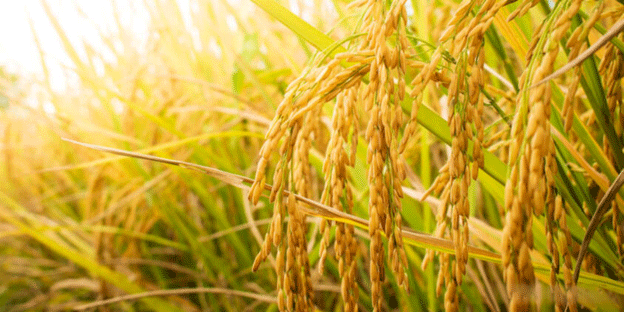
Russian rice cultivation predominantly features varieties of the ‘japonica’ type, specifically the ‘italica’ subtype, characterized by medium-length grains. In 2024, several new varieties were introduced, including:
- Bodrum: A medium-maturing, round-grain variety developed by “AFG National.” It has been patented and included in the State Register of Breeding Achievements.
- Adriatica: A medium-late, large-grain variety also from “AFG National,” recognized for its high yield potential.
- Corsica: A late-maturing, long-grain variety, completing the trio of new introductions by “AFG National.”
These varieties have undergone state trials and are recommended for cultivation in specific zones of the Krasnodar Krai.
Russia’s rice production has seen remarkable growth, with 2024 marking a record harvest of 1.26 million tons—a 17.2% increase from the previous year. This achievement is attributed to the expansion of cultivation areas and the adoption of advanced agronomic practices. The introduction of new, high-yielding varieties further underscores the country’s commitment to enhancing rice production to satisfy both domestic consumption and export markets.
Error