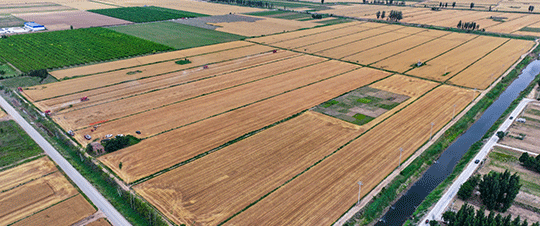
As golden wheat fields sway in the summer breeze, Langfang City in Hebei Province has officially begun its large-scale “Three Summers” (三夏) mechanized harvesting operations. On June 16, combine harvesters rumbled across thousands of acres of wheat fields in Dacheng County, marking the start of a highly efficient harvest season.
Strong Yields and Efficient Operations
According to Li Lei, head of the Shengkai Grain Planting Farmers’ Cooperative, this year’s wheat harvest is expected to yield over 1,100 pounds per acre, with 6,000 acres being harvested in just three days. Langfang has planted 129.87 million acres of wheat, which will be fully harvested in about 10 days with the help of 17,000 agricultural machines.
To ensure smooth operations, Langfang has established 41农机维修网点 (41 machinery repair stations) and 45跨区机收作业服务站 (45 cross-regional harvest service stations), providing support such as fuel, food, and emergency supplies for machine operators. Additionally, the city has implemented 24-hour hotlines and priority transport lanes for harvest equipment in collaboration with traffic authorities.
Minimizing Losses with Precision Agriculture
The Langfang Agricultural Machinery Technology Promotion Station has emphasized the importance of reducing harvest losses to below 0.86% by using advanced, eco-friendly harvesters and optimizing settings such as reel speed, cutting height, and threshing drum RPM. Farmers are encouraged to test harvest sample plots before full-scale operations to fine-tune machinery.
Seamless Transition to Next Crop
Once wheat harvesting concludes, Langfang’s 4,100玉米播种机 (corn planters) will take over, utilizing GPS-guided precision seeders and no-till planters to ensure optimal spacing and depth for corn and soybean crops. This approach enhances seedling uniformity and strength, laying a solid foundation for the next harvest.
Langfang’s success highlights the critical role of mechanization, real-time support systems, and precision agriculture in maximizing yields and efficiency. By integrating technology with strategic planning, farmers can achieve higher productivity while minimizing waste—a model for sustainable modern farming.
Error