• About
  • Advertise
  • Careers
  • Contact
Saturday, December 13, 2025
  • Login
No Result
View All Result
Field Crops news
  • Home
  • News
  • AgroTech & Innovation
  • Science
  • Sustainability
  • Market News
  • Research & Development
  • Home
  • News
  • AgroTech & Innovation
  • Science
  • Sustainability
  • Market News
  • Research & Development
No Result
View All Result
Field Crops news
No Result
View All Result
Home Research & Development

Ramularia leaf spot of barley: raising the awareness on disease symptoms

by Maria YEROKHOVA
25 June 2024
in Research & Development, Science
0
Ramularia leaf spot of barley: raising the awareness on disease symptoms
0
SHARES
6
VIEWS
Share on FacebookShare on Twitter

Barley is a field crop of increasing importance due to increased resilience to many abiotic stresses of this crop and many health benefits for human health of consumers. But there are a number of barley diasese affecting this field crop and causing significant losses.

One of such a fungal disease of barley is  ramularia leaf spot, caused by Ramularia collo-cygni. This disease is seedborne and airborne, although the relative importance of these sources is not well understood.

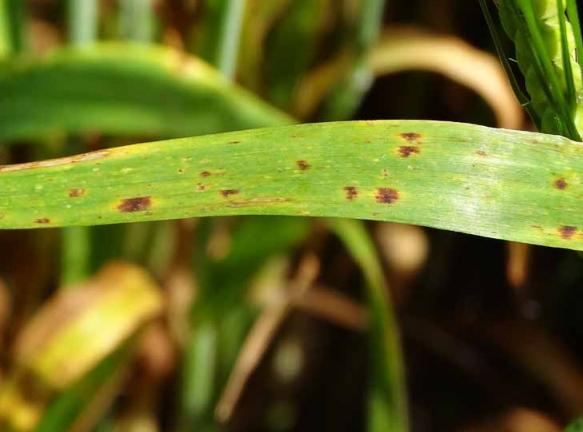
Typical symptoms of ramularia comprise small, reddish/brown, rectangular lesions, often surrounded by a yellow margin (halo) of chlorosis.

Following high levels of infection, leaves may senesce rapidly. Lesions are often obvious on dead leaves as black spots, with fungal spores visible.

The disease is often associated with other leaf spots, such as abiotic sun scorch, physiological leaf spot, the spot-form of net blotch and spotting caused by damage to the leaf wax following the application of some fungicides.

If the following ‘5Rs’ are associated with mature lesions, it is highly likely to be ramularia:

Reddish/brown colouration.

Rectangular shape.

Restricted by the leaf veins.

Ringed with yellow margin of chlorosis.

Right through the leaf.

With control increasingly difficult, it is essential to recognise the presence of ramularia leaf spot and its severity. Assessments conducted late in the season can inform rotational decisions and reveal the potential risks associated with farm-saved seed. It is important to avoid saving seed for resowing from heavily infected crops.

Source: https://ahdb.org.uk/

Error

Tags: airborne diseaseBarleybarley diseaseseedborne disease

Maria YEROKHOVA

Next Post
Prominent Figures and Fresh Faces: Key Movements in the Grain Industry

Prominent Figures and Fresh Faces: Key Movements in the Grain Industry

Newsletter

Australian Grain Prices Surge Amidst US Market Bounce and Freight Concerns

Australian Grain Prices Surge Amidst US Market Bounce and Freight Concerns

6 September 2024

Wheat Prices Rise as Imports Drop: Key Market Trends and Insights for Farmers

10 November 2024

Reviving Valivov’s Legacy: Afghan Frost-Resistant Wheat Shows Promise for Modern Agriculture

21 July 2025

Russia’s Best-Selling Corn Hybrid: Why Krasnodarsky 291 AMV Is Leading the Fields

23 March 2025

Harvesting Corn in Stavropol: A Key to Russia’s Food Security

4 September 2024

Weather Impacts and Market Shifts: Updates from Victoria’s Agricultural Front

23 June 2024

Bulgarian-Chinese Business Forum to be Opened by Agriculture Minister Dr. Georgi Tahov

25 June 2024

Barley Grass Market Set for Exponential Growth from 2024 to 2031

29 July 2024

The Empty Silos of Altynkol: Decoding the Kazakhstan-China Grain Trade Deadlock

9 December 2025

South Korean Mills Secure 90,000 Tons of Wheat from the US and Canada: What This Means for Global Wheat Markets

19 July 2024
  • About
  • Advertise
  • Careers
  • Contact
Call us: +51 93 999 5140

© 2020-2024 Field Crops news

Welcome Back!

Login to your account below

Forgotten Password?

Retrieve your password

Please enter your username or email address to reset your password.

Log In
No Result
View All Result
  • Home
  • News
  • Science
  • Sustainability
  • AgroTech & Innovation
  • Market News
  • Science
  • Research & Development
  • About
  • Contact

© 2020-2024 Field Crops news